this must be archive.php

Luspatercept – lobby your local MP!

MDS Patient Support

Luspatercept (also known as Reblozyl) is a drug widely used in the US, EU, Australia and Canada to treat MDS patients.

It was expected to be available in the UK by now, but last year the manufacturer, Bristol Myers Squibb, withdrew its application to NICE for licensing in the UK.  The reasons for this are unclear but believed to be commercial.

Luspatercept can be beneficial for MDS patients, especially those with a particular sub-type, and BMS’s decision to withdraw was a blow to the blood cancer community.

One of our members, Angela Wilson, has successfully lobbied her local MP, Chancellor and ex Health Minister Jeremy Hunt, who has personally agreed to take this up with current Health Minister Victoria Atkins.

Campaign for Luspatercept in the UK


To lend your voice to this campaign you could lobby your own local MP. We've drafted a letter you may like to use which you can download from here.


Shingles vaccine: now available from age 50 for the immunocompromised

Shingrax Shingles vaccine for the immunocompromised 2024


The shingles vaccine is now available for those aged 50 and over with a suppressed immune system - which includes those with MDS and CMML. Your GP surgery will usually contact you when you become eligible but speak to your GP if you haven't yet been contacted.


What is the Shingles vaccine for?

The NHS website states

Shingles is a common condition that causes a painful rash. It can sometimes lead to serious problems such as long-lasting pain, hearing loss or blindness. You're more likely to get shingles, and it's more likely to cause serious problems, as you get older or if you have a severely weakened immune system.

The shingles vaccine helps:

•reduce your chances of getting shingles

•reduce your chances of getting serious problems if you do get shingles

For more on shingles see https://www.nhs.uk/conditions/shingles/ 


Shingrix non-live vaccine

People with weakened immunity receive the non-live vaccine, Shingrix, which involves two doses given 8 weeks to 6 months apart. For more information see Shingrix vaccine patient leaflet (Electronic Medicines Compendium website; PDF only, 136kb)

Important

You can get shingles more than once, so it's important to get vaccinated even if you've had it before. Don’t delay. If you are eligible, try to have your vaccine as soon as possible.

For more information


Covid lateral flow tests for the immunocompromised:  now available from pharmacies

Covid-19 lateral flow test - free from chemist for immunocompromised
Access arrangements for Covid-19 tests have recently changed.  Eligible patients - which includes those with CMML and MDS – can now get free lateral flow tests (LFTs) at their local chemist, as these can no longer be ordered through the government website or via NHS 111.
You can either pick the tests up yourself or ask someone to do it for you.  You (or your representative) will need to take proof of eligibility, which can be your letter of diagnosis, or any consultant or GP letter which mentions your condition and/or the supportive care you are receiving.  It is possible your regular pharmacy may already have a record of your condition, but it’s worth taking proof just in case.


For more information


See 'Treatments for COVID-19 - NHS' (www.nhs.uk) for more details.


‘Lifestyle medicine for improving health & wellbeing’ – a presentation by Dr Shireen Kassam


Dr. Shireen Kassam MB BS, FRCPath, PhD, DipIBLM is a Consultant Haematologist and Honorary Senior Lecturer at King's College Hospital, London. She is is also a certified Lifestyle Medicine Physician and is passionate about promoting the benefits of plant-based nutrition for the prevention and reversal of chronic diseases and for maintaining optimal health after a cancer diagnosis.
In this video Dr Kassam presents a 35-minute introduction to evidence-based Lifestyle Medicine. She explores how it can empower individuals living with MDS, offering practical actions to enhance health and well-being.  The session was chaired by Maureen Sturrock, Local Patient Support Ambassador (Scotland region).

Dr Shireen Kassam, consultant haematologist and Honorary Senior Lecturer at King’s College Hospital, London and a certified Lifestyle Medicine Physician.

MDS Patient Support

Top 5 Wellness Tips

MDS Patient Support
Photo by Brett Jordan on Unsplash  

Just a reminder from us here at MDS UK, to get in tune with a few tips to increase and maintain a balanced and healthy lifestyle. Remember to tailor solutions to your needs and seek medical advice from your CNS/GP to fit your individual requirements. 

Nutrition  

Most people have their favourite dish which they could easily have a few times a week, whether it’s a very green salad or a super cheesy lasagne, the key is balance. Remember to limit processed and sugary food and drinks.  

Keep fruit, nuts, and seeds as part of your intake, as well as whole grains, healthy fats, vegetables and water. It’s also important be mindful of portion sizes. 

Watch out! During the colder months, we see a variety of new hot drinks and snacks brought to the menus of our favourite places. As amazing as a “Sweet Caramel Crunch Cake and Vanilla, Hazelnut and Chocolate Wonder Latte” sounds, be mindful of the sugar in the powders and syrups – they can be sneaky! Try to opt for more herbal teas than sugar- filled temptations.  

MDS Patient Support
Photo by Taylor Kiser on Unsplash  

Movement  

We’re not saying to run uphill every day, but it’s important to get moving! To support a healthy brain and improve bone and muscle strength, incorporate some movement into your daily routine. This can include walking, stretching, swimming, cycling, or badminton. It’s key to keep up with having good circulation, coordination, concentration, improved mood, and reflexes. 

MDS Patient Support
Photo by Lucas van Oort on Unsplash  

Rest  

Not getting enough sleep? Make it a priority to adjust your routine before bedtime. Although it is tempting and very easy to end up watching 2 seasons back-to-back, when you’re done, it could be 4am. Yikes!  

Consider setting a wind-down alarm to remind you to start getting ready for bed. Let’s say you want to be in bed for 9pm, try to start your night routine at 7:30/8pm to give yourself enough time. During this time, instead of watching television, maybe read a few pages of a book and have tea instead of sugary snacks. 

Sleep helps with improving your memory, weight management, creativity, concentration, and the feeling of being energised.  

Quality of sleep is important too, not just the eight hours. For example, drinking too many liquids before bed could have you heading to the bathroom multiple times throughout the night! 

MDS Patient Support
Photo by Rehina Sultanova on Unsplash  

Hydration  

Seeing as the body is made up of approximately 60% water, it makes sense that we make sure to get enough of it. You don’t need to be severely dehydrated in order to feel the effects. 

Constipation, brain health and levels of energy are all affected by water, try to have one litre of water a day – but avoid having a bulk of water in the evening to save you from the midnight trips to the bathroom! 

As the festive season approaches there may be more booze available at dinner than usual, but still remember that you need adequate water. 

MDS Patient Support
Photo by Kobu Agency on Unsplash  

Hobbies  

This is a great way to relax at any time of day, meet new people and develop a skill. Hobbies can help you to avoid the feeling of being bored or engaging in habits that don’t support you having healthy, balanced life.  

You can search for clubs and groups in your local area to meet others with similar interests, such as chess or painting classes. You could try puzzles, model building collecting items, dance class or hiking adventures.

MDS Patient Support
Photo by Rifqi Ali Ridho on Unsplash  

September 2023 is Blood Cancer Awareness Month

The MDS Alliance is raising awareness of myelodysplastic syndromes (MDS), a rare group of blood cancers. This year's campaign targets patients, healthcare professionals, and the general public and aims to highlight awareness about; MDS symptoms, diagnosis and treatment options, and self-management of the disease.

About Myelodysplastic Syndromes

For more detailed information, explanations, videos or to download our patient handbook 'Understanding Myelodysplastic Syndromes', see What is MDS?
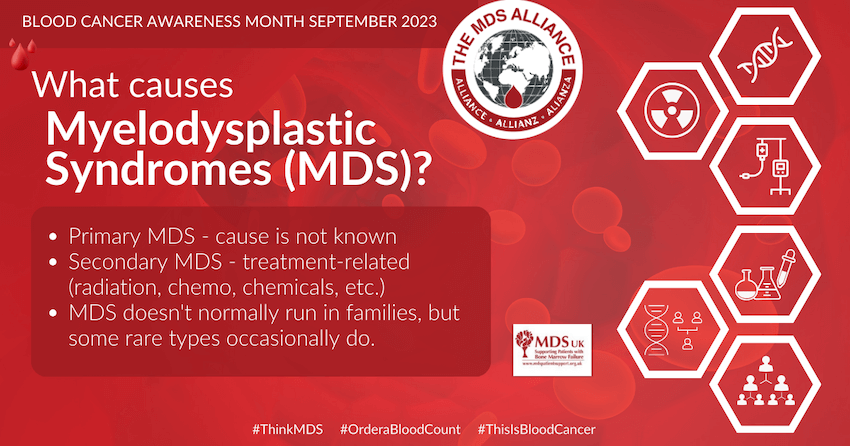
The cause of MDS remains largely unknown although there are many research groups around the world who are trying to improve our understanding of why it occurs and in whom.

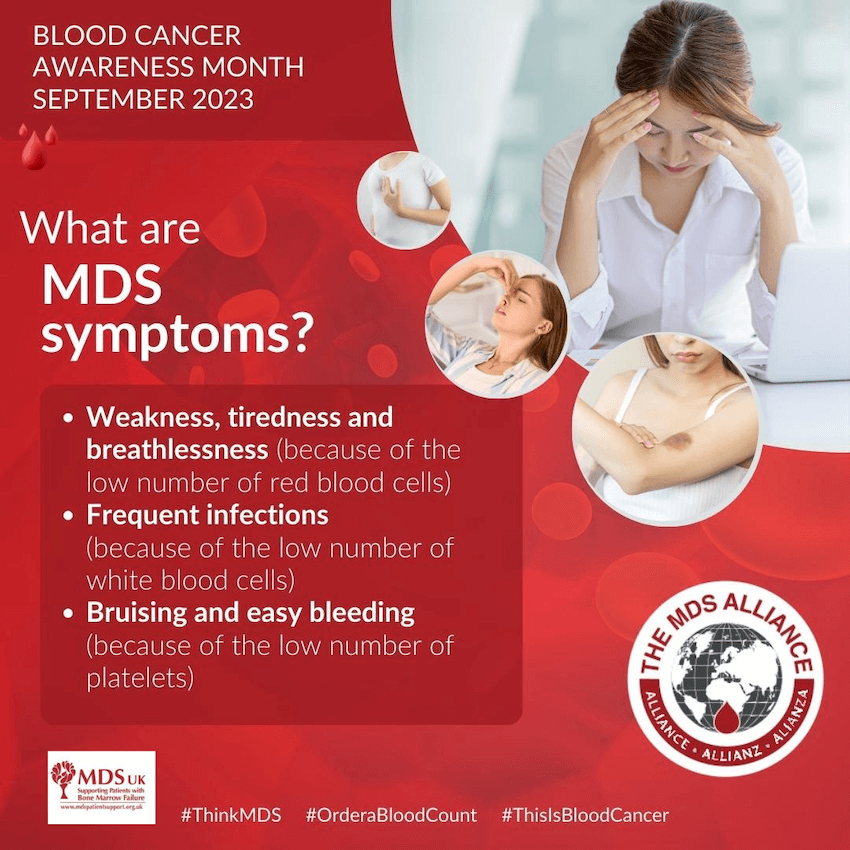
What are the symptoms of MDS?

If you spot the symptoms of MDS, take next actions quickly. 

MDS is difficult to diagnose so by raising awareness of the signs and symptoms and taking action to get a blood test, the campaign aims to improve diagnosis.  As with all cancers, fast action enables faster diagnosis and better treatment. For more see MDS Symptoms

If you notice the signs or symptoms above, Get a #BloodCount

If you feel you have the symptoms outlined above, you can get a very simple bloodtest at your local GP called a full or complete bloodcount.

A Complete Blood Count (CBC) is a very common blood test that is often part of a routine checkup. The test counts the cells that make up your blood: red blood cells, white blood cells, and platelets and the results can determine if further investigation into MDS is required. If you see the signs and symptoms, get a complete #BloodCount


Complete Blood Count test

How is MDS diagnosed?

Click or tap the arrows to see the slides.
For more see MDS Diagnosis

How is MDS treated?

Click or tap the arrows to see the slides.
For more see MDS Treatments

How can others support people with MDS?

The NHS Blood Donation website  explains how to become a blood donor; where you can give blood, about the donation process, and how to make an appointment. It's such a worthwhile thing to do, and really does save and improve lives.

Visit the Anthony Nolan website to find out more about how to donate bone marrow, and how to join the stem cell register (it’s easy!)

Download a brochure about MDS

Download brochure about MDS

For more information, download the A5 brochure about MDS from the MDS Alliance.


Congratulations to our amazing team MDS UK who ran the iconic Great North Run!

The start was very hot which made running tough but our Great North Run team made great time. Thankfully all our runners were through before biblical rain hit the site. It certainly was a memorable day.

""

Fiona Christie and Chris Newton

Fiona from Turiff and her brother Chris from North Berwick ran for their Mum, Marion who was diagnosed in 2012. 

“We are both delighted to be running in the Great North Run 2023 for MDS UK. Our Mum was diagnosed with MDS in 2012 and gets ongoing support and information from MDS UK. The Great North Run is extra special for us as it takes place in Newcastle which is our dads hometown, (Howay the lads (&lassies)) Mum & Dad are both coming down to support us on the day and it will be amazing to have them along with us and see them when we cross the finish line ?”

Fiona's race time - 02:06:01

Chris' race time - 02:00:18


Carol Archer 

Carol (in the red) is from Sunderland and is a friend of our acting CEO Debbie Hickman and her late husband Neil. 

Carol's race time - 02:36:39

James Law 

James ran for his dad Colin Law

“Unfortunately my dad has MDS and so I’ve chosen to do the GNR to raise funds for the charity that is providing him with help and support. I hope that you can support me, him and the charity also with a kind donation!”

James' race time - 01:57:50

Richard Kadar 

Another fantastic race run by Richard (after raising over £2,000 from a run back in 2022.)

Richard's race time - 01:49:16

Thank you 

We would like to extend our heartfelt thanks to all our runners. Your hard work and commitment to MDS UK Patient Support is greatly appreciated and makes a huge difference to the lives of those affected by MDS and CMML.

If you would like to join the 2024 team, please get in touch. Registration is free and minimum sponsorship is £375 – contact Ashleigh Venables at fundraising@mdspatientsupport.org.uk


Flu & COVID-19 vaccines brought forward to September 11th 2023

How to get your Covid-19 vaccine this autumn 2024

The Flu and COVID-19 vaccine programmes will start earlier than planned this year, on September 11th, because of the emergence of a new COVID-19 variant, BA.2.86.

This is a precautionary measure as BA.2.86 is not currently classified as a variant of concern, but advice from UK Health Secretary Agency suggests that speeding up the autumn vaccine programme will give greater protection, supporting those at greatest risk of severe illness and reducing the potential impact on the NHS. Health secretary Maria Caulfield explained,

"As our world-leading scientists gather more information on the BA.2.86 variant, it makes sense to bring forward the vaccination programme...It is absolutely vital the most vulnerable groups receive a vaccine to strengthen their immunity over winter to protect themselves and reduce pressure on the NHS."

Flu and COVID-19 vaccines will be offered together

The annual flu vaccine will also be made available at the same time, wherever possible, to ensure people are protected ahead of winter.

Specific groups to be offered the booster vaccine from September 11th 2023 are (as outlined by the The Joint Committee on Vaccination and Immunisation)
    • residents in a care home for older adults
    • all adults aged 65 years and over
    • persons aged 6 months to 64 years in a clinical risk group, as laid out in the Immunisation Green Book, COVID-19 chapter (Green Book). (Please note, this applies to all people with MDS and CMML).
    • frontline health and social care workers
    • persons aged 12 to 64 years who are household contacts (as defined in the Green Book) of people with immunosuppression
    • persons aged 16 to 64 years who are carers (as defined in the Green Book) and staff working in care homes for older adults.

For more information from gov.uk


NHS England will announce full details of the accelerated roll-out soon, and those who fall into higher-risk groups are being encouraged to take up the jab as soon as they’re invited. For more detail, follow the link to the official press release from gov.uk 


MDS World Awareness Day 2023

MDS Patient Support


What is MDS World Awareness Day?

Every year on October 25, we come together with the MDS Alliance and others, to raise awareness of Myelodysplastic Syndromes (MDS).
Join us and support the campaign on behalf of MDS patients globally. There are lots of ways you can get involved; whether it's wearing one of our T-shirts for the day, sharing vital information about MDS signs and symptoms through social media, or by donating to MDS UK.  Whatever you can do will go towards improving the lives of MDS patients worldwide.

Why raise awareness?

Rare diseases like MDS often get misdiagnosed, forgotten or ignored. By raising awareness and sharing information, the hope is to
  • enable early detection and treatment of MDS by making people aware of the signs and symptoms. As with all cancers, fast action enables better treatment
  • foster understanding among the public about the challenges MDS patients face
  • help people to have more informed conversations with their healthcare professionals enabling access to specialist care when needed

Join us!

1 - Like and share our posts on social media using the hashtags below, and tag @MDSUK


Hashtags
#MDSWAD2023
#thinkMDS
#Bloodcount

Tag us @MDSUK

2 - Download and print posters to put up in your local community

Click or tap on any of the thumbnail images below to download a poster for your local GP surgery or supportive care setting.


Bruising

Breathless

Weakness

Fatigued

3 - Donate to MDS UK on our Just Giving page

All funds, no matter how modest, are always welcome, every few pounds can truly make a big difference.

MDS UK Patient Support Group raises awareness of MDS, offers support and information to patients and families, campaigns to improve quality of life and make treatments available to those affected by Myelodysplastic Syndromes. Please donate to our Just Giving page.


REPAIR-MDS – a ground breaking clinical trial for low/intermediate risk MDS

October 2024 - Update


Repair-MDS is now closed to recruitment.  Once there are results and data available, which is expected to be in early-mid 2025, we will post this here.

On behalf of the trial managers, the clinical team, and ourselves on the PPIE (Patient and Public Involvement and Education) front, can we take this opportunity to say a big THANK YOU to those members who signed up and actively participated.

A new diagnosis of low/intermediate risk MDS can be shocking – hearing you have cancer, that it's life limiting and that there are very few treatments available, may well be distressing. Often, the only real option for patients is to return home and 'watch and wait' until the next appointment, usually three months away. The REPAIR-MDS trial offered a chance to get involved in one of two new experimental treatment options.
MDS Patient Support

What is the REPAIR-MDS trial?


REPAIR-MDS is a ground-breaking clinical trial that aims to improve the symptoms and overall quality of life for patients with low/intermediate risk Myelodysplastic Syndromes.  Patients were put randomly into one of two treatment groups below. Both groups used drugs which are already used safely for other diseases (Repurposed drugs). 

Treatment Group 1 VBaP - Sodium Valproate (V), Bezafibrate (Ba), Medroxyprogesterone (P) 

Treatment Group 2 : Danazol.  

The study is trying to find out if these ‘repurposed’ drugs can be used to treat MDS patients and to improve their blood counts, reduce their need for transfusions, improve their quality of life, and prolong their survival.

Where are the trial sites?


The trial is taking place throughout the UK, is coordinated by the University of Warwick’s Clinical Trials Unit and was open in around 30 hospitals.

Follow the link to the REPAIR-MDS website for a regularly updated list of REPAIR-MDS trial sites

What's the trial duration?


September 2020 - June 2025


To find out more


Get more information from the trial website below.

REPAIR-MDS Trial Website

The REPAIR-MDS trial website which has regularly updated information about who to contact, trial eligibility criteria, trial sites and more.

REPAIR-MDS Central Management Team


MDS Patient Support

Dr Stephen Jenkins is Lead (Clinical) Chief Investigator on the REPAIR-MDS trial and consultant haematologist at Russells Hall Hospital, Dudley.

MDS Patient Support

Dr Manoj Raghavan is Deputy (Clinical) Chief Investigator on the REPAIR-MDS trial. He is a consultant haematologist based at the Centre for Clinical Haematology.

MDS Patient Support

Professor Janet Dunn is Co-Chief Investigator & Professor of clinical trials & head of cancer trials at - Warwick Clinical Trials Unit.

MDS Patient Support

Sophie Gasson is a PPI Research Fellow at Warwick Clinical Trials Unit.

A brief introduction to REPAIR-MDS from Co-Chief Investigator Dr Manoj Raghavan

Watch the recorded webinar on the REPAIR-MDS Clinical Trial from February 13th 2023

Free donations by shopping