this must be archive.php

QoL (Quality of Life ) in High-Risk MDS & AML: A recorded zoom session with specialist consultants & MDS UK patients


On December 15th 2022, Dr Pramila Krishnamurthy, and her colleagues Dr Beth Payne, and Dr Ian Thomas, led this valuable session introducing their research project on QoL (Quality of Life ) in High-Risk MDS & AML to a group of MDS UK patients. The presentation was followed by Q&As.

Below is a recording of that session. It was chaired by Sophie Wintrich, CEO and Trustee of MDS UK Patient Support Group. The recording is approximately 1hr 10m. For more on the specialist speakers, see their profiles below.

Specialist speakers

Dr Pramila Krishnamurthy, Consultant Haematologist King's College Hospital, London

Dr Pramila Krishnamurthy is a haematology consultant at King’s College Hospital, London. She specialises in AML, MDS and BMT. She was awarded the John Goldman Leukaemia UK Fellowship in 2021.

Dr Beth Payne, Consultant Haematologist UCLH

Dr Beth Payne is haematology consultant at UCLH and specialises in the treatment of MDS and bone marrow failure. She undertook her PhD at the Dana-Farber Cancer Institute, Harvard Medical School in Boston, USA studying molecular aspects of MDS and AML and ribosomal protein mediated disorders. Dr Payne was awarded an Advanced Clinician Scientist Fellowship by Cancer Research UK. 

Dr Ian Thomas is a Research Fellow within the Blood Cancer group, at the UKCRC Registered Centre for Trials Research at Cardiff University. He has worked on international clinical trials, predominantly in acute myeloid leukaemia, since 2007. 


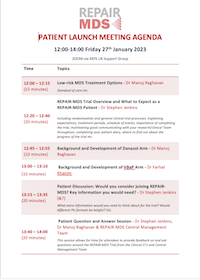
27th January – Patient meeting on Low-risk MDS and Repair MDS with Professor Manoj Raghavan & colleagues


Professor Manoj Raghavan, Consultant haematologist, University Hospital Birmingham and a team of specialists involved in Repair MDS, will be leading a presentation via Zoom on Low-Risk MDS. The topics covered will include;

  • the standard treatments available
  • the trials for this type of MDS
  • the new clinical trial Repair MDS, using re-purposed drugs.

The meeting would be of interest to patients with Low-Risk MDS, 'watch & wait' or pre-MDS. This meeting will be recorded and available on the website later.

Meeting details

Date:     Friday 27th January
Time:    12 noon to 2 pm
Where:  Online, Zoom Call

To register in advance for this meeting click on the red button below. After registering, you'll receive a confirmation email with information about how to join the meeting.

Subtitles on Zoom for the hard of hearing 

We are aware that if you have a hearing impairment, you may have avoided registering for our Zoom meetings because you were worried you wouldn’t be able to hear what people were saying.

With the latest Zoom updates, MDS UK is now able to offer live subtitles at all our Zoom online meetings. It isn't perfect, as all of you used to using subtitles will know, because it depends on the clarity of each speaker! But it will help you to follow the conversations and join in the discussion.

If you would like to use this service, please make sure you request it in the questions and comments when you register for the Zoom meeting. Our Office Manager, Caroline, will then be able to set it up in advance and guide you through the process on the day of the meeting. It’s quite straightforward to set up and we hope it will enable more of you to join us.

Getting used to Zoom

It doesn't seem likely we'll be able to resume face-to-face meetings for a while yet, so we're continuing our virtual meetings on Zoom (as we know how important patient to patient contact is for everyone.) Even when face-to face meetings resume, we aim to maintain some virtual meetings as well, as these have attracted new members who had not come to face-to-face meetings previously. 

Many patients have already embraced Zoom (or something similar) in order to stay in touch with family members during the lockdown. If you haven't, please contact us.  If you are a first time user of video call – please don’t worry as we will sort out any technical issues at the start of each meeting.

If you have not contacted the MDS UK Patient Support Group before and would like to receive a full Patient Information Pack, please contact our Main Office.


MDS UK Main Office

0207 733 7558


Could you be a patient / carer representative for King’s Health Partners Haematology?


King's Health Partners Haematology are looking for two patient/carer representatives to sit on the KHP Haematology programme board. Interested patients/carers should register their interest by contacting becky.barnes@kcl.ac.uk / 07773 147379 by 31st January 2023

"We are looking for two enthusiastic and committed patient or carer representatives to be part of the Kings Health Partners Haematology Programme Board.

Our Haematology Clinical Academic partnership is developing a world-leading patient-centred Haematology programme that takes the latest research from bench-to-bedside, supporting and training healthcare professionals to provide the best possible care for people with blood diseases."


Low risk MDS: A recorded presentation by Dr Dominic Culligan & MDS UK patients


On November 21st 2022, Dr Dominic Culligan, consultant haematologist at Aberdeen Royal Infirmary, led this valuable session on Low risk MDS, to a large group of MDS UK patients.

The session was chaired by Maureen Sturrock, Local Patient Support Ambassador for Scotland and Chris Dugmore, Essex Group Coordinator, Volunteer & Volunteer Coordinator. The presentation is followed by Q&As between Dr Culligan and a group of patients. The recording is approximately 1hr 50m.

Dr Dominic Culligan, consultant Haematologist, Aberdeen Royal Infirmary

Dr Dominic Culligan is a consultant haematologist and honorary senior lecturer at Aberdeen Royal Infirmary and The University of Aberdeen. He is lead clinician for malignant haematology and specialises in the management of acute myeloid leukaemia, MDS and the lymphomas. He is a member of the NCRI AML Working Group and past Chairman of the NCRI MDS Clinical Trials Sub Group. Dominic has been a clinical advisor to the MDS Patient Support Group for many years and a founding member and current Chairman of the UK MDS Forum.


Malignant Diagnosis Surely?

MDS World Awareness Day October 25th 2022 - Malignant Diagnosis Surely?

Can you imagine being diagnosed with a condition and your healthcare team omitting to mention it is a type of cancer? Yet this has been the case for some people diagnosed with MDS. MDS is a type of cancer and it is important that everyone calls it a cancer.

By not mentioning the term ‘cancer’ immediately at diagnosis, and not explaining low-risk vs high-risk, there is a risk that patients find out by chance, as soon as they look up any information after their initial appointment, like reading the NHS website. The shock of that discovery, when alone, and the lack of medical staff to check with can be traumatic for many. 

As a result of misunderstanding their diagnosis, patients might not receive the support that they are entitled to, such as employment rights and access to psychological and financial support. This must change.

Leukaemia Care and MDS UK are working together as part of a Malignant Diagnosis, Surely? campaign.


Our Malignant Diagnosis, Surely? campaign aims to ask NHS bodies to:

  • Ensure patients get access to cancer care reviews from their GPs and the support of clinical nurse specialists for blood cancers
  • Include MDS in NHS cancer data collection (e.g. including them in the Cancer Patient Experience Survey and the Cancer Quality of Life Metrics project).
  • Issue communications to healthcare professionals regarding the importance of  referring to MDS as a blood cancer, and explaining low vs high-risk types at the point of diagnosis.

Malignant Diagnosis Surely?

Support the campaign further

Send us your stories of diagnosis. What was your experience?

  • Were you told at diagnosis that MDS is a form of blood cancer?
  • If not, how did find out?
  • What was it like finding out in that way?
  • Were you told at diagnosis that there is a low risk and high risk of MDS?
  • Send us your stories to info@mdspatientsupport.org.uk and we'll put them up on our Stories of Diagnosis page
  • Share your MDS story using the hashtags #MDSWAD2022 to show your support for the campaign.

MDS World Awareness Day – October 25th 2022


Every year on October 25, the MDS Alliance and their member groups around the world, come together to raise awareness of Myelodysplastic syndrome (MDS), a type of rare blood cancer, where the bone marrow does not produce enough healthy blood cells. This year's focus is to support earlier diagnosis by highlighting the signs and symptoms of MDS .

Spot the symptoms of MDS and take next actions quickly. 

MDS is difficult to diagnose so by raising awareness of the signs and symptoms and taking action to get a blood test, the campaign aims to improve diagnosis.  As with all cancers, fast action enables better treatment and faster diagnosis. The earlier the diagnosis, the better.

So if you notice these signs get a #BloodCount

Bruising

Fatigue

Breathlessness

Weakness

Speak to loved ones, care givers, family members, partners

We may not notice ourselves just how frequently we are feeling tired, or how quickly we get out of breath for activities that used to feel easy. But our loved ones can notice these changes much more easily. The campaign urges us all to be aware if our loved ones are experiencing symptoms and to encourage them to act and get checked out via a full bloodcount/complete blood test.

If you spot the symptoms get a #BloodCount

A Complete Blood Count (CBC) is a very common blood test that is often part of a routine checkup. The test counts the cells that make up your blood: red blood cells, white blood cells, and platelets and the results can determine if further investigation into MDS is required. If you see the signs and symptoms, get a complete #BloodCount


Complete Blood Count test

10 facts about MDS

Find out more about MDS with these 10 key facts


MDS UK 2022 Christmas Cards – just arrived!

Christmas cards in aid of MDS UK

This is the third year Christine Peel and her grandchildren have produced beautiful Christmas cards in aid of MDS UK. This year’s cards are designed by her grandson Victor (also the grandson of our MDS UK’s Chair, Ted Peel, of course!) and we’re sure you will love the new designs.

How to order MDS UK Christmas cards 2022

The cards are £7.50 for a pack of 10.  You can have a mixed pack of 5 each for the same price too. To order your pack/s contact Christine Peel via email at  n1cmp@yahoo.com   

A big THANK YOU!

To Christine and Ted, and their family, for raising funds and awareness of MDS.  Today, more than ever, we need people like the Peel family, to help us support MDS patients and their families. 

And you huge thank you in advance to you for buying your Christmas cards in aid of MDS UK, your contributions are very much appreciated.

MDS UK is the only charity in the UK providing vital support, information and advice, and conducting research solely into Myelodysplastic Syndromes (MDS). We're a small charity that needs your support to maintain its services - so every contribution makes a big difference.

The cards are kindly produced by Bastion Art, Dover for a discounted charity rate, thank you.


NHS is running out of blood: Service declares first ever ‘amber alert’ amid dwindling supplies

NHS Give Blood logo

Blood can only be stored for 35 days

NHS Blood and Transplant (NHSBT) has declared an amber alert on its blood stocks which are running dangerously low, and a call is going out for people to make emergency donations.

Nationally, there is less than two days' supply of O negative blood — the universal type which hospitals are reliant on in emergencies.  Unless supplies get back on track quickly, the NHS Blood and Transplant service could upgrade the situation to a 'red' alert, which could see all but the most serious emergency surgeries cancelled.

NHSBT say maintaining stocks has been a challenge in the wake of Covid, partly due to fewer people visiting collection centres in towns and cities.  Staff sickness because of the virus has also led to cancellations so NHS staff are being moved to the front line to open up more appointments.

NHS Blood and Transplant blood stocks are critically low - if you're fit and healthy, please make an emergency donation now

Call NHS Blood and Transplant on 0300 123 23 23 to book

As the situation is so urgent, the phone lines are unusually busy so you may have to wait a while to get through - but do hang on, you will get through and they will book you an appointment.

Or visit the NHS Blood and Transplant website

Due to the urgency of the situation, the NHS Blood and Transplant website can also become very busy so they have implemented a queuing system. If the website is too busy you will see a page like the image below. It will give you an indication of how long you will have to wait to get online. Do be patient, you will get online eventually - alternatively you could try calling number above.

NHS Blood donation website queuing system

What does a shortage mean for MDS sufferers?

About 70% of all patients suffering from Myelodysplastic Syndrome are anaemic and become blood transfusion dependent during the course of their disease. Since their anaemia is “refractory”, they are in need of regular blood transfusions, with many requiring red blood or platelets several times per month, to stay alive.

Severe anaemia causes extreme fatigue, breathlessness, dizziness, and – if no action is taken, death, if the blood levels drop critically low.

MDS patients – please ask your healthy relatives and friends to become or remain a volunteer donor. Please spread the word about the urgent need to help stop the threat of low blood stocks worldwide. Please talk about it around you.


Blood Cancer Awareness Month – Weakness #ThinkMDS


September is Blood Cancer Awareness Month and this year, the MDS Alliance is running a 4-week campaign #ThinkMDS.

#ThinkMDS aims to raise awareness of blood cancer, and specifically MDS, a rare group of blood cancers. The focus is for people (particularly Health Care professionals and care-givers) to spot the symptoms of MDS and to take next actions quickly. Fast action enables better treatment and faster diagnosis.

Blood Cancer Awareness Month 2022 - Weakness #ThinkMDS

Blood Cancer Awareness Month 2022 - #ThinkMDS

Muscle weakness is one of the signs of MDS.

A complete blood count can determine if further action is required. So if patients report muscle weakness, #ThinkMDS and #OrderaBloodCount

If you spot the symptoms #ThinkMDS #OrderaBloodCount


  • A Complete Blood Count (CBC) via your GP can easily determine if further investigation into MDS is needed. #OrderaBloodCount
Complete Blood Count test

#OrderaBloodCount

A Complete Blood Count (CBC) is a very common blood test that is often part of a routine checkup. The test counts the cells that make up your blood: red blood cells, white blood cells, and platelets and the results can determine if further investigation into MDS is required. #OrderaBloodCount


About Myelodysplasic syndromes (MDS), a group of rare blood cancers

Myelodysplasic syndromes (MDS) are a group of rare blood cancers where patients don't have enough healthy blood cells.  Symptoms vary from person to person and depend on which blood cells are low.  About 8 in 10 patients have anaemia, whilst about 2 in 10 present to their doctor with infections or bleeding.

  • Anaemia is due to a lack of red cells (also referred to as a low haemoglobin), which may lead to fatigue and shortness of breath even on light exertion.
  • Recurrent and persistent infections are another common symptom of MDS, due to low white cell counts.
  • When your platelet count is low, you can suffer from easy bruising and bleeding. This can sometimes manifest itself as a rash on the skin. These are tiny bleedings under the skin called petechiae and often appear where clothes are tight fitted, like around the ankles or waist. Nose or gum bleeds can also be a sign of a low platelet count.
  • Some MDS patients have no signs or symptoms, and are diagnosed by chance as a result of a routine blood test.

As a support group, we have seen hundreds of cases where diagnosis of MDS was delayed. Delays means impaired quality of life for most patients, frequent infections, and for some, a worse prognosis.

If you notice these signs - #ThinkMDS #OrderaBloodCount

  • September 2022: Week 1 - Bruising
  • September 2022: Week 2 - Fatigue
  • September 2022: Week 3 - Breathlessness
  • September 2022: Week 4 - Weakness

Bruising

Fatigue

Breathlessness

Blood Cancer Awareness Month: 2022 Weakness  #ThinkMDS

Weakness


Register for AGM – all welcome!


Free donations by shopping