this must be archive.php

Pharma companies to share experimental compounds with UK researchers

A ground-breaking collaboration project between Medical Research Council in UK and seven leading pharma companies has been announced, as drugmakers agreed to share data on their experimental pharmaceutical compounds. British academics will now be able to use pharma’s existing findings to further test these compounds and explore if they could be improved or used for other indications.

This is an incredibly useful step for both research and also in terms of improved cooperation with the pharma industry, with a huge potential for improving the health of patients in the UK and worldwide.

Full article on this innovative collaboration is available on MRC website (click here to access) but for the benefit of our readers full text also copied below:


Seven pharma companies offer up compounds to UK researchers

21 Jul 2014

UK researchers will be granted access to a ‘virtual library’ of deprioritised pharmaceutical compounds through a new partnership between the Medical Research Council (MRC) and seven global drug companies, announced today by Business Secretary Vince Cable.

AstraZeneca, GlaxoSmithKline, Janssen Research & Development LLC*, Lilly, Pfizer, Takeda and UCB will each offer up a number of their deprioritised molecules for use in new studies to improve our understanding of a range of diseases, with a view to developing more effective treatments.

The compounds have undergone some degree of industry development, but have all stalled at some point in early testing – often because they are not sufficiently effective against the disease in question. However, they may still be useful against other diseases with shared biological pathways.

These compounds are incredibly valuable to academic researchers, who can use them to understand how a disease takes hold in the body and how it might be stopped or slowed down. It is hoped that re-purposing such compounds could lead to the development of new medicines for many debilitating conditions. And because the compounds have already undergone some preliminary development, such as safety testing, any new treatments arising from the research could reach patients much faster.

Projects funded through a previous compound sharing initiative between the MRC and AstraZeneca are already demonstrating success in this area, with the first human trials of a new treatment for chronic cough getting underway (see case study below).

Professor Sir John Savill, Chief Executive of the Medical Research Council, added:

“Our ground-breaking compound collaboration with AstraZeneca attracted a huge amount interest from the academic community and saw the MRC award £7 million for research into Alzheimer’s, cancer and rare diseases. We’re now building on this success by expanding into a rolling programme with seven companies that will allow the academic community to access even more assets for use in innovative research projects. By funding studies using these compounds, which otherwise would not be carried out, we will enable scientific breakthroughs that will improve the health of patients in the UK and worldwide.”

A full list of available compounds will be published later this year, when UK scientists will be able to apply for MRC funding to use them in academic research projects. There is no fixed budget for the programme, which will make the compounds available on a continuous basis via the MRC’s normal response-mode funding mechanism. It is hoped that more companies, and more compounds, will be added as the scheme progresses.

Stephen Whitehead, Chief Executive of the Association of the British Pharmaceutical Industry (ABPI), said:

“This partnership between the Medical Research Council (MRC) and seven pharmaceutical companies is a fantastic example of open innovation that benefits both industry and academia by opening up new interesting avenues for research that may not otherwise be available, or even redirecting towards other diseases. The ABPI and our members are committed to greater collaboration with UK researchers and the whole of the academic community to improve our understanding of diseases so that we can continue to develop life-changing medicines for the benefit of patients. “

Research proposals will be submitted to the MRC, which will independently judge the scientific quality of the applications and award funding accordingly. The rights to intellectual property (IP) generated using the compounds will vary from project to project, but will be equitable and similar to those currently used in academically-led research.

Case study: from acid reflux to chronic cough

A number of the projects funded through the MRC’s previous compound sharing collaboration with AstraZeneca, launched in December 2011, are already beginning to bear fruit.

In Manchester, clinical trials are underway to see whether a drug designed originally to treat gastro-oesophageal reflux disease can be ‘repurposed’ to treat chronic cough.

Cough is the single most common reason that people seek medical care. It is thought that one in five people in the UK suffer from chronic coughing (lasting longer than eight weeks), which can have a huge impact on their quality of life.

Previous work by The University of Manchester researchers, led by Professor Jacky Smith, found that in around half of people with chronic cough, the cough reflex is related to gastro-oesophageal reflux, where the stomach contents escape back up into the food pipe causing a burning sensation.

It is hoped that the repurposed drug, which was not found to be helpful in patients with heartburn who were already taking acid-blocking treatments, may be successful in improving cough.

Further information

*A Johnson & Johnson company in collaboration with Johnson & Johnson Innovation

To request an interview with Professor Jacky Smith or an MRC spokesperson, or one of the seven companies involved in the partnership, contact Hannah Isom in the MRC press office on 0207 395 2345 (out of hours: 07818 428 297) or email press.office@headoffice.mrc.ac.uk.

SOURCE: MRC. (21 July 2014). Seven pharma companies offer up compounds to UK researchers [Press release], Retrieved from http://www.mrc.ac.uk/news-events/news/seven-pharma-companies-offer-up-compounds-to-uk-researchers/


Newsletter 5 is out!

NEWSLETTER 5 – June 2014

We have just finalised our 5th edition of our MDS UK Newsletter.

It is a bumper issue – with 16 pages – as we had a lot of information and news to cover.
In the past, we had editions of 8 and 12 pages.
We would appreciate your comments and feedback, in order to keep improving our newsletter for you, our readers.
Also let us know what else you’d like to read about – or if you’d like us to feature more – or less – of certain topics.

As ever – all registered members of MDS UK will receive a paper copy sent to their home address by the end of June.
If you have not received yours by the 1st July – please call or email us, so we can check your registration details.

All hospitals will also receive a stock of newsletters.
If your hospital is not registered with us, please contact us – and we’ll mail you all relevant information.

Patients and families – if you can’t see our leaflets and newsletters in your hospital – please ask staff to contact us – or let us know – we’ll send stocks of material to your hospital.

[one_fourth]
Newsletter5-Front

[/one_fourth]

[three_fourth_last]

June 2014

Our fifth edition of the MDS UK Newsletter is now out. Click the image to download.

[/three_fourth_last]

Previous editions of our newsletters and how to order them for hospitals can be found here:
https://mdspatientsupport.org.uk/what-is-mds/newsletter/


19th Congress of the European Hematology Association – 12th-15th June 2014

EHA logo

19th Congress of the European Haematology Association (EHA) has taken place this year between 12th and 15th June in Milan, Italy.

This event is set up for physicians and representatives of patient support groups to  promote excellence in patient care, research and education in haematology.

As part of the Worldwide Alliance of national MDS Patient support and advocacy groups, MDS UK representative – Sophie Wintrich – attended this event to better serve the MDS patient and caregiver community.Print
We have provided below a brief summary of the Patient Advocacy Track and activities.
As usual, interesting MDS clinical news and updates will be provided separately and posted on our website, Facebook and our Newsletter 6.
This year Dr Wendy Ingram in Cardiff kindly agreed to write up on MDS News at EHA.

This year for the first time, the EHA congress program is complemented by a dedicated Advocacy Track. This track combines all patient and policy related sessions into one, comprehensive yet very diverse program for those interested in advocacy in haematology, patient advocacy and other related topics; and will involve:

  • EHA Patient Advocacy Booth (booth #206)

This is a central meeting place of all patient advocates and their peers

EHA booth1-web   EHA booth3-web

  • Patient Advocates Meeting (FRI 11:30-12:30, Room Yellow),

This is a meeting for all patient advocates in order to strengthen collaboration and links between our patient advocacy groups

EHA patient meeting1-web   EHA patient meeting3-web

  • Patient Advocacy Session “Generics in Haematology: The doctors’ and patients’ perspective” (Sat 8:00-9:15, Room Amber 5+6 SW 2)

This session will outline how patients can be involved as partners in clinical research and how the challenges of informed consent, trial results, and ethics in bio banking can be turned into opportunities.
EHA19 Chair Comments – Part 1 – Generics in Hamatology: The doctors’ and patients’ perspective
Jan Geissler

EHA19 Chair comments – Part 1 – Generics in Hematology: The doctors’ and patients’ perspective
Androulla Eleftheriou

Drug quality in generics, substandard drugs, copies – the pharmacologist perspective
Atholl Johnston

Use of generic drugs and discussions with the government on drug quality
Mahmoud Hadipour Dehshal

The hematologists’ clinical perspective
Ivana Urosevic

The patients’ perspective
Sarunas Narbutas

VIDEO clips of all talks here

  • Patient Advocacy Session “The challenges of young patients with old people’s diseases” (Sat 9:30-10:15, Room Amber 5+6 SW 2

Old people’s diseases in young patients with chronic rare anaemias, Sexuality, fertility, family planning in haematological diseases.

  • ESH-EHA Joint Symposium “What do you mean, he can’t have the treatment?  An interactive session for haematologists and patients” (Sat 11.45-12.45, Amber 5+6 SW2)

This  renowned interactive EHA/ESH Joint Symposium will deal with how to explain to a patient that he/she can no longer receive treatment that is endorsed by national guidelines as her/his best option, or, in short: ‘what do you mean, I can’t have the treatment’?
EHA-ESH session-web

This interactive role playing session showed the importance of doctor patient communication in consultation – as well as patient – family interaction.  MDS UK gets many calls from patients who don’t feel comfortable asking too many questions, or requesting an additional opinion from an MDS expert at a Centre of Excellence.  Doctor patient communication is sometimes not easy for either party, especially when it comes to difficult diagnosis – but it can be improved.

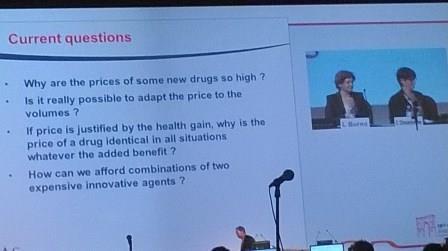
  • EHA-ASH Joint Symposium “Access to medicines and fair pricing: The cost of innovative drugs” (Sat 14 June, 13:15-14:15, Room Silver, NW 2)

This EHA/ASH Joint Symposium will present a transnational view on the effects of the financial and economic crises, happening against a backdrop of an ageing population and an increasing prevalence of non-communicable diseases that weighs down heavily on health care budgets.
EHA-Drug price-web     EHA-drug price2-web
This was a really interesting session, inviting Prof JL Harousseau (ICO, France) and R Bergstroem, (EFPIA), to discuss the reasons why drug prices are so high.
Prof Harousseau is professor of haematology at the University of Nantes, France and Chairman of the French National Authority for Health (HAS). HAS can be compared to NICE, but operates more independently from Government.  He was questioning why more can’t be done to lower prices by using drug volumes.  He also asked why drug prices are identical, whatever the added benefit.
R Bergstroem is head of EFPIA: The European Federation of Pharmaceutical Industries and Associations represents the pharmaceutical industry operating in Europe.
He argued that Research and Development costs of past and future drugs need to be paid for, and that industry researchers are entitled to become millionaires or multi-millionaires (sic) should their drugs be effective and successfull.   Marketing of those drugs also needs to be paid for.

We thought that the questions were extremely good ones, but sadly, the head of EFPIA failed to raise to the challenge to answer them in a tone and professionalism this EHA audience of doctors and patient advocates expected.  Very disappointing.
The topic of drug prices is a truly difficult one – and will require a lot more flexibility from all involved to make innovative drugs available.

VIDEO – JP Harrousseau at EHA 2014

  • EHA Advocacy Session “The Future of Haematological Research in Europe” (Sat 14 June, 16:15-17:30, Room Amber 5+6, SW 2)

This is EHA’s own advocacy session highlighting EHA’s advocacy work and illustrating the importance of politics by the case of personalised medicine.

  • Scientific Working Group on Quality of Life (Thurs 18.30-20.00)

We welcome the addition of the Advocacy Track to the EHA congress programme and encourage our members to access the webcasts of the relevant sessions, which will be freely available to all on EHA website.

We will also post them on our website – when they become available – and open them up for comments on our on-line discussion forum.

20/06/14
We just added some photos of the EHA congress and the very successful Patient Advocacy Track, attended by many physicians and patient advocates from all over the world.

We thank the EHA Board again for their continued support, partnership and cooperation with patient advocates and look forward to EHA 2015, with some exciting new themes for the now very well established EHA Patient Advocacy Track.
We also congratulate this year’s EHA President Dr Christine Chomienne and all of the EHA teams and contributors for the most successful EHA congress to date – with an amazing 10.400 attendees.
And many thanks to patient advocate Jan Geissler from EUPATI and CML Advocates, for being such a strong and passionate spokesperson for all patient advocacy issues.
Finally thank you to all patient support group representatives and colleagues who attended EHA this year, helped man our patient advocacy booth, answered physician queries and requests and contributed to all patient advocacy sessions.
We hope to see many more of you at EHA 2015 in Vienna!

UPDATE – SEPTEMBER 2014 – video clips of most talks are now available from the EHA website:
http://www.ehaweb.org/news/eha-news/advocacy-track-eha19/generics-in-hematology/

Videos for 2013 EHA Advocacy sessions are available here:
EHA Advocacy 2013 – talks

 EHA booth4-web


Research Project in Scotland – artificial blood an alternative to blood transfusions

A new and very promising research project is being conducted at the University of Edinburgh with an aim to generate red blood cells in laboratory, using stem cell technology. Ultimately it is hoped that these red blood cells could be given to patients instead of using human blood donors. Using lab-generated blood, which is also infection-free, is thought to offer additional benefits particularly to those relying on regular transfusions.

Although the scientific project is still in its early stages, Dr Emma King – one of the researchers working at the University of Edinburgh – is eager to include patient views on using lab-generated blood. The team would like to set up some face-to-face interviews in Scotland to gather opinions from different groups of patients.

She sent us this message to identify MDS patient interviewees:

“My name is Dr Emma King and I am a researcher at the University of Edinburgh, based in a research group which looks at social science to do with the life sciences.

 I am currently working with a team of scientists who are seeking to grow red blood cells in the laboratory, with the aim of eventually reducing the requirement for human blood donations. My job is to find out what people think about this new technology.

 I am looking for a small number of volunteers who are transfusion dependent and live in Scotland to take part in an interview. This will involve a discussion with me about your experiences with MDS and your thoughts towards this potential new blood product. We are not able to pay you, but we are happy to travel to your home or another convenient location. The interview will last around an hour and will be voice recorded. You are welcome to have a friend or relative join in the interview with you. This project has full ethical approval from the University of Edinburgh and I am happy to provide more information about how this data will be stored and used”

Project conducted by:

Science, Technology and Innovation Studies (STIS)
School of Social and Political Science
The University of Edinburgh
Old Surgeons’ Hall
High School Yards
Edinburgh EH1 1LZ

Please visit their website for further details.

If you are interested in being interviewed by Dr Emma King, please contact our Main Office:

Tel: 02077337558
Email: mds-uk@mds-foundation.org


Greater Manchester opportunity for involvement

This is an opportunity for patients and relatives to get involved in Primary Care issues in the Greater Manchester area.
It would be beneficial if Myelodysplastic Syndromes were represented, so as to improve awareness of the disease generally – and make sure their needs are met.

We were asked to share the following information:

Call for applicants to become a member of the GMPSTRC Core Research User Group

The GM PSTRC (Greater Manchester Primary Care Patient Safety Translational Research Centre) is currently looking for new members to join their Research User Group either as a Core or Associate member.  You will need to use NHS primary care services (GP surgeries or pharmacies) in Greater Manchester, have a keen interest in health research and be able to commit to regular meetings (fees and expenses reimbursed).  For more information about the different types of membership and to download an application pack, please visit their website. (www.gmpstrc.nihr.ac.uk)
Please get in touch with this group directly if you are interested.

Thank you


Regional Patient Groups – in association with Leukaemia Care

Regional Group Meetings, by Leukaemia Care

Leukaemia CARE is a national blood cancer support charity. It provides vital advice and information to anyone affected by a diagnosis of blood cancer: Leukaemia Care Website

Our organisations are mutually beneficial and complementary.

On the link below you’ll be able to find some regional groups offered by our colleagues of Leukaemia Care:

Leukaemia Care: Find a Support Group

Important Note:  The Leukaemia Care groups are open to all types of malignant haematology/blood cancer patients – not just MDS – so please don’t be surprised to meet patients with other types of blood disorders.

Many blood cancer patients will have several issues and symptoms in common – and you will therefore benefit from talking to one another.

Typical issues will be: blood transfusions, fatigue, iron chelation, emotional burden and unpredictability of the disease, weakened immune system and infections, bone marrow transplants and many more probably.

Find an MDS UK Patient Support Group Meeting


Rare Disease Day – 28/02/2014 – London Reception – all welcome

Rare Disease Day – A special reception at the Science Museum, London

When: Friday 28th February 2014

Time: 12noon to 2pm

Where: Exhibition Road, South Kensington, London, SW7 2DD

On the occasion of Rare Disease Day, a special reception has been set up in conjunction with a year-long campaign called Challenge the Unchallengeable, which aims to increase understanding in the UK of rare diseases and their impact on patients’ lives.
A sculpture will also be unveiled on the occasion – featuring 2000 raised hands – described as follows:
“Your hand will become part of a powerful, contemporary art installation that will be designed by an aspiring British artist. The installation will bring 2,000 hands together as 1, thus serving as a lasting reminder of our combined efforts against rare diseases.  This piece of art will be prominently unveiled on 28th February (Rare Disease Day) 2014, so you will have the opportunity to go and see your hand in the installation and meet others who have made a difference”.

Website http://www.raiseyourhand.co.uk/news

Patients and families are invited to attend this reception – which MDS UK will attend as well – to mark this special day for MDS as a Rare Disease.
We hope to see some of you there.
If you are planning to attend – PLEASE MAKE SURE YOU RSVP – for catering purposes:

Juliet – PR for Raise Your Hand
Tel 01273 208356MDS Patient Support01273 208356 – or – 0778 465 2520MDS Patient Support0778 465 2520
Email julietmorrison@btconnect.com

Please specify name and number of people attending.  Thank you.
Only a few spaces are now left for the exclusive unveiling this art installation on #RareDisease Day.

More information about this campaign
The campaign aims to increase awareness that as many as one in 2,000 people are affected by a rare disease, many of which are relatively unknown to the general public and in some cases, even to healthcare professionals, yet they have a devastating impact on patients and families.

The idea is that by running stories in the press on people who have a rare disease, tied into the story of the campaign,that we attract 2,000 people to the Raise Your Hand website.
This event is organised and sponsored by pharma company Alexion.

More events and information about International Rare Disease Day 2014


This Rare Disease Day 2014 video is now available in seven different languages for you to enjoy and to share. With the focus on Care this year, the 2014 video poignantly demonstrates the kind of care people with rare diseases need and deserve, and the ways family members, health professionals, and the entire rare disease community are working together to provide care.

Created in Barcelona by production company These Glory Days, the Rare Disease Day 2014 video is accompanied by the music of Delorentos, who generously offered the use of their aptly named song Care For.

Besides These Glory Days and Delorentos, a big round of applause goes out to the many individuals and families living with a rare disease who appear in the video, including Maria and Judit; Luis; Roman and Mireia and Carla; Arturo and David; Carla and Bertie and Jordi; Isaac; Nacho and David; as well as the health professionals and researchers who participated. The cooperation in joining together to create the Rare Disease Day 2014 video is emblematic of the unity and solidarity patients and families, professionals and policy makers, researchers and industry are demonstrating to find treatments and care for people with rare diseases. Be a part of the Rare Disease Day momentum – share the Rare Disease Day 2014 video and let’s show the world that it is entirely possible to Join Together for Better Care.
Louise Taylor, Communications and Development Writer, EURORDIS

Feel free to organise your own Rare Disease Day locally – and let us and the following organisations know what you have planned:
Rare Disease UK http://www.raredisease.org.uk/rare_disease_day_2014.htm
And http://www.rarediseaseday.org/news
Genetic Alliance UK http://www.geneticalliance.org.uk/index.html
Facebook – Rare Disease Day https://www.facebook.com/rarediseaseday

EURORDIS http://www.eurordis.org/

Rare Disease UK: “We will be holding receptions in England, Scotland and Wales to mark Rare Disease Day 2014. We will also work with our colleagues in the NIRDP (Northern Ireland Rare Disease Partnership) to hold an all-Ireland event in Belfast on Rare Disease Day.

This year we will be focusing on the importance of implementing the UK Strategy for Rare Diseases which was recently launched on 22nd November. More information on the UK Strategy is available here.”

To register at one of their events across the UK, please follow the links below:
Welsh Assembly, Cardiff – Tuesday 11th February 6pm – 8pm
Scottish Parliament, Edinburgh – Tuesday 25th February 6:00pm – 8:00pm
House of Commons, London – Wednesday 26th February 4pm – 6pm (This event is now full, please check back at a later date for available tickets)
Riddell Hall, Belfast – Friday 28th February 10:30am – 3pm

Contact Campaign – Rare Disease UK needs your help in contacting politicians in each of the UK’s home nations to raise awareness of rare diseases and to encourage them to attend their parliamentary events. You can download template letters and find out more information here.

Your activities to mark Rare Disease Day – we encourage you or your organisation to conduct awareness or fundraising activities of your own to tie in with Rare Disease Day.Things members have done in the past include:
– Organising conferences/events
– Conducting awareness days in schools
– Producing Rare Disease Day materials/literature
– Holding cake/jumble sales etc
– Conducting local media activity
– Holding special Rare Disease Day promotions in charity shops
– Holding stands at hospitals with information about their condition
– Holding Rare Disease Day activities in the workplace

Follow Rare Disease Day on Twitter: @rarediseaseday


Important survey on availability of medicines in Europe

Important new survey started by EHA – the European Haematology Association.
EHA is interested in finding out if certain medicines are not available in some parts of the country – or in some parts of Europe.
This survey can be completed by anyone who is aware of a shortage or lack of a medicine in the UK or Europe:
Patients, relatives, doctors, nurses, patient groups.

We have a problem…

Many European doctors tell us that the most effective medicines are often not available for their patients. Irrespective of whether this is due to shortages, or because the medicine is not affordable or is not marketed in specific countries or for any other reason, lack of access to essential medicines is clearly a problem for hematologists. And in Europe this problem appears to be growing.

MDS Patient Support

MDS Patient Support

MDS Patient Support

MDS Patient Support

Access to medicines problems occur across the board in medicine, but research amongst pharmacists indicates that hematology is in the top 5 specialties that suffer the most from lack of availability of medicines. 

We all know that prioritizing patients, substituting standard regimens with substandard ones or choosing unproven treatment options can have serious consequences for both patients and practice. As the EHA, we feel these risks should be addressed and we believe that access to medicines is an issue that should be high up on the European political agenda. To achieve this, we need your help.

Whenever you find a hematology medicine is not available, please let us know; systematically collecting evidence is the first step in addressing these problems effectively.

MDS Patient Support

MDS Patient Support

MDS Patient Support


MDS Patient Support

MDS Patient Support

MDS Patient Support

In short, we call on you to help strengthen our efforts to improve patients’ access to medicine across Europe and report unavailable hematology medicines to EHA today!

Please fill out the ‘unavailable medicines’ form. You can find the form on the EHA website  or click here to access it directly.

Filling out the form will take no more than 5 minutes.

Thank you! 


MDS Beacon articles – for the latest research and trial updates

The MDS Beacon is a great source of information on MDS.

There you can find the latest research articles – in a language patients can understand.
We used some of their articles in our latest newsletter – but if you’d like to read more, do check their website online:

http://www.mdsbeacon.com/tag/research-summary/

For example:

Campath May Be Effective In Some Patients With Lower-Risk Myelodysplastic Syndromes

A small retrospective study by German researchers suggests that a short course of treatment with the im­mu­no­sup­pres­sive agent Campath may be safe and ef­fec­tive in patients with lower-risk myelo­dys­plastic syndromes who are good can­di­dates for im­mu­no­sup­pres­sive therapy.
More on http://www.mdsbeacon.com/news/2013/08/30/campath-lower-risk-myelodysplastic-syndromes/

Half Of MDS Patients With Chromosome 5 Deletion Also Have Important Genetic Mutations

European researchers recently published results of a study looking at genetic mutations in myelodysplastic syndromes patients with a deletion in chromosome 5.

In their study, the researchers focused on 25 genes that often are mutated in patients with myeloid disorders, which include myelodysplastic syn­dromes (MDS), acute myeloid leukemia, and several other diseases.
More on http://www.mdsbeacon.com/news/2013/10/01/mds-del-5q-chromosome-5-deletion-genetic-mutations/

Zolinza Plus Cytarabine May Be A Good Treatment Option For Higher-Risk MDS Patients Following Vidaza Treatment Failure

Results of a recent Phase 1 clinical trial conducted in France show that treat­ment with Zolinza and low-dose cytarabine is safe and possibly more effective than current treat­ment options for higher-risk MDS patients who no longer respond to Vidaza treat­ment.
More on http://www.mdsbeacon.com/news/2013/10/23/zolinza-vorinostat-cytarabine-after-vidaza-failure-mds/

Do check in regularly.

http://www.mdsbeacon.com/


Comments on Cancer Drug Fund – by Myeloma UK

17/11/13 – Article by our great Myeloma UK  colleague Eric Low – about the Cancer Drug Fund.

“Cancer Drugs Fund: Friend and Foe?

An article by Myeloma UK Chief Executive Eric Low on the National Cancer Drugs Fund (CDF) has been published in the November edition of the Pharmafocus. Eric has been invited to write this column on a monthly basis for the magazine.

The article calls for a more effective long-term solution to the challenge of approving new cancer drugs for use on the NHS.”

The full article on page 19 of the magazine is available here:http://tinyurl.com/o676eml


We fully endorse Eric comments and views on the subject, not only because it is only a temporary measure, but also because it is not available everywhere in the UK.


Free donations by shopping