this must be archive.php

Introducing our new patrons

We are delighted that two eminent people have recently agreed to become patrons– Professor Ghulam Mufti, Professor of Haematology at King’s College Hospital in London – and Tariq Ahmad, The Lord Ahmad of Wimbledon.

Professor Ghulam Mufti

MDS Patient Support

Professor Mufti – whom many of you already know as his patients – is an internationally renowned specialist in MDS. He is the head of the haematology department at King’s College Hospital in London. He commenced his training in haematology at Radcliffe Infirmary, Oxford, and Hammersmith Hospital Royal Postgraduate Medical School. Because of his interest in pre-leukaemic states, in 1981 the Leukaemia Research Fund awarded him a fellowship in Bournemouth, Southampton & Royal Postgraduate Medical School. He was appointed as senior lecturer in haematological medicine and consultant haematologist in May 1985.

He has extensive clinical and research expertise in myelodysplastic syndromes (MDS), leukaemias, and lymphomas. The Unit at King’s is one of the leading centres for Bone Marrow Transplantation in MDS. He heads the research groups and works with a team of nine other professors who are experts in various medical fields including gene therapy, stem cell biology, bone marrow transplants, plasma cell dyscrasias and immunotherapy of myeloid malignancies, in particular MDS. Professor Mufti also leads 86 researchers who focus on treating leukaemia. He has published over 400 original papers and chapters in scientific journals and textbooks on leukaemias. He devised the prognostic score (Bournemouth score for MDS) and contributed to the IPSS scoring system. He was a member of the working group that produced national and international guidelines on the treatment and prognosis of MDS. He is a founding member of the Board of the International Myelodysplastic Foundation of which his Department at King’s College Hospital is a recognised Centre of Excellence.

Prof Mufti adds: “The MDS Newsletter is an emotional milestone for me, for MDS as a disease has at last come to the forefront of scientific and translational research. I am confident that the research will translate into real therapeutic benefit to all our MDS sufferers not just in the UK but worldwide.

Lord Tariq Ahmad

MDS Patient Support

Tariq Ahmad’s career has been in the City of London in corporate banking and marketing and currently serves as Marketing and Strategy Director at a leading commodity and financial futures and options firm, Sucden Financial, where he has been a member of executive team since 2004. A business graduate, he has extensive experience of financial services and the City spanning over almost 20 years. Joining NatWest in 1991, he spent almost 10 years with the Group in corporate banking and strategy roles before joining the US funds and investment house, Alliance Bernstein. Lord Ahmad, was Vice Chairman of the Conservative Party (2008-2010), has been active in local government in London, contested Croydon North in 2005 and became a Conservative Life Peer in the House of Lords in 2011. He is a Member of the Institute of Directors and is greatly involved in charity work.

We are very grateful to both for taking on this important role.


Are you Fit to Spit ?

DEC 2013

An update on the Sharon Berger #Spit4Mum Campaign, led by her children Jonni and Caz, to increase stem cell donations amongst the Jewish community (Dec 2013).

FIT TO SPIT clip – Beatbox style!

All you young fit men out there – we still need your help.

Here is why:

Our fantastic treasurer – Sharon Berger – is now unfortunately in need of a stem cell transplant – and needs a suitable donor URGENTLY.

No perfect match has been found since mid-December – so we are searching for new donors, in the hope to find a better match.

Sharon was going to start azacitidine – whilst waiting for a suitable donor – but due to a severe infection over Christmas, the azacitidine treatment was not possible.  She has now had to start chemotherapy instead.

If a suitable match is not found in the next 6 weeks, Sharon will need to take the risk of going ahead with a bone marrow transplant with either cord blood or her son’s stem cells – both not an ideal match.

This means the risk of complications and the bone marrow failing is much higher and chances of survival quite lower.

Even with a perfect match, transplants can fail.

So… here is what you can do to help:

Register as a donor on the Anthony Nolan registry if you are aged 16-30 years old.  You will be sent a spit kit – very easy.

http://www.anthonynolan.org/What-you-can-do/save-a-life/Online-application.aspx

General enquiries: 0303 303 0303

If you are already on the registry – make sure your contact details are up to date.

Aged 18-55 ?  Delete Blood Cancer – Donate Stem Cells

Delete Blood Cancer UK -Tel: 020 3176 7660

Or contact the British Bone Marrow Registry:
http://www.nhsbt.nhs.uk/bonemarrow/qa/index.asp#howcan
They accept donors up to the age of 50 years old – if they are registered blood donors.

Any questions call the Donor Helpline: National Blood Service 0300 123 23 23

If you or someone you know is expecting – the cord blood can be donated at birth – just need to register at http://www.nhsbt.nhs.uk/cordblood/

MDS Patient SupportIf you can’t donate in person: Please share this page as widely as possible.

Your action might help to increase Sharon’s chances of a successful transplant.

You can encourage people to register as a group, with colleagues, neighbours, fellow students.

Below you will find further information about donating stem cells – which can save someone’s life.

Do something amazing – and give the gift of life to someone who needs it urgently – be it your family, friends or a complete stranger.

All further details are explained on the Anthony Nolan website – incl how to register, what happens if you are a match for someone, the 2 options for donating and how you will feel. http://www.anthonynolan.org/What-you-can-do/save-a-life.aspx

As Sharon is of jewish origin – The Jewish Chronicle – and the jewish community is particularly keen to help.

As TJC article below specifies, Sharon’s best match would be an Ashkenazi Jew, with heritage from Russia and Lithuania.  But we encourage everyone to register and check if they might be the match she needs.

MDS Patient Support

17 Dec 2012

Sharon will be having 4 weeks of chemo first to reduce her blast count – then move onto the stem cell transplant.

Thank you for helping us help Sharon – and many others who need their perfect donor match.

UPDATE 20 Dec 2012

As no suitable donor has yet been found – Sharon will be starting a 3 month treatment with azacitidine – in the hope to slow down the progression of the disease – and to buy more time before the transplant.

We hope to find a better match in those 3 months.

Please don’t stop sharing this information!

Update 08 Jan 2013

Still no good donor – despite many people coming forward.  We need to pursue the search urgently.

Azacitidine treatment not possible, as Sharon had a severe infection over Christmas.

She now had to start chemotherapy.  Thank you.

MDS Patient Support


If you are connected to students – please tell them about the search.


Totally Jewish.com:
http://www.totallyjewish.com/news/national/c-19196/race-against-time-to-save-mum/

http://totallyjewish.com/the_jewish_news/view/c-19200/jewish-news-jn-776-10012013/ (link expired on website)

London Standard article – 11/01/2013

Lucy Tobin: Mock all you like but social media can be a considerable force for good
Lucy Tobin – Published: 11 January 2013
Standard – Lucy Tobin – Social Media – a force for good

The Londonist
www.londonist.com/2013/01/things-to-do-in-london-today-15-january-2013.php

“A new section in which we highlight a different charity or appeal you might be interested in. Send ideas to matt@londonist.com

Every day in this article, we highlight the places in London where you can donate blood in London. But have you heard about blood stem cell donation? Those with leukaemia and other blood diseases can be saved with bone marrow transplants, but they need to find a donor with suitable cells. If you’re 16-30, the best thing you can do is join the Anthony Nolan register. You’ll be sent a ‘spit kit’ so the lab chaps can work out your cell type, which then enters their database to aid the hunt for future donor matches. Those over 30 can also donate, but should discuss it at a blood donor clinic first. You could be the last chance for someone on death’s door. This appeal was nominated by Jonni Berger, who’s currently seeking a donor to help his mum Sharon Berger (Twitter campaign #Spit4Mum).”

Here is a clip on what it means to donate stem cells:


This lady for example would not be here today if not for the donation of some stem cells by a complete stranger:

Twitter: Hashtag #Spit4Mum – set up by Sharon’s children.

Spit4Mum

This is Sharon’s son’s Facebook page:
Jonni Berger

www.facebook.com/jonnibgood

Here is a further collection of press articles around the Sharon Berger donor campaign.Her children Jonni and Caroline have been working tirelessly to give interviews and set up donor registration events all over the country.

Sharon had intensive chemotherapy – and is battling on – and the search for a donor continues so that the transplant she so desperately need can go ahead.

Wanted: Bone marrow for Jewish mother
By JPOST.COM STAFF – 01/13/2013 18:03
London family turns to social media to help find donor for mom undergoing chemotherapy. http://www.jpost.com/JewishWorld/JewishNews/Article.aspx?ID=299437&R=R1

Click here for Facebook page – MDS UK Patient Support Group.

http://totallyjewish.com/the_jewish_news/view/c-19200/jewish-news-jn-776-10012013/ (link expired on website)

Wanted: Bone Marrow For Jewish Mother
London family turns to social media to help find donor for mom undergoing chemo
Jewish Herald Article

BBC – Sick woman’s appeal sparks rise in Jewish bone marrow donors
Sharon Berger will need a donor of Ashkenazi Jewish heritage
The number of Jewish bone marrow donors registered with a charity has risen by 985% as a result of a campaign to save a terminally ill woman.
30 January 2013 Last updated at 06:25
www.bbc.co.uk/news/uk-england-21250095

ITV
www.itv.com/news/london/story/2013-01-14/bone-marrow-needed/

BBC – Urgent plea for bone marrow donor
27 January 2013 Last updated at 13:06
www.bbc.co.uk/news/uk-england-21219684

BBC – London siblings’ bone marrow Twitter plea boosts Jewish donors
19 January 2013 Last updated at 16:53
www.bbc.co.uk/news/uk-england-london-21089305

Race Against Time to Save Mum’ 10 – 01-2013
Comments Off by: stephen-oryszczuk in: National,News
The family of a mum-of-two from Kenton, who is undergoing last-ditch treatment for a rare form of cancer, this week made an urgent plea to young Jewish News readers to register as bone marrow donors.
www.totallyjewish.com/news/national/c-19196/race-against-time-to-save-mum/

THE JEWISH CHRONICLE ONLINE
Life-saving drive starts for bone marrow
By Anna Sheinman, December 17, 2012
www.thejc.com/community/community-life/94158/life-saving-drive-starts-bone-marrow-donor

Jerusalem post

Wanted: Bone marrow for Jewish mother – By JPOST.COM STAFF
01/13/2013 18:03
London family turns to social media to help find donor for mom undergoing chemotherapy.
www.jpost.com/JewishWorld/JewishNews/Article.aspx?ID=299437&R=R1

www.totallyjewish.com/the_jewish_news/view/c-19200/jewish-news-jn-776-10012013/Expired link

METRO – Cancer sufferer needs rare bone marrow donation within six weeks to save her lifeWednesday 16 Jan 2013 12:27 pm
www.metro.co.uk/2013/01/16/cancer-sufferer-needs-rare-bone-marrow-donation-within-six-weeks-to-save-her-life-3354464/

Brother and sister battle against the clock to find bone marrow donor to save their Kenton mother’s life – 11:15am Thursday 24th January 2013
www.harrowtimes.co.uk/news/10182748.Brother_and_sister_battle_against_the_clock_to_help_save_mother_s_life/

Twitter appeal boosts bone marrow register
Thursday, 24 January 2013
www.barnet-today.co.uk/News.cfm?id=2484&headline=Twitter%20appeal%20boosts%20bone%20marrow%20register

nolan spit4mum

ANTHONY NOLAN – on the Sharon Berger Campaign

www.anthonynolan.org/News/SHARON-BERGER-CAMPAIGN-LEADS-TO-500–INCREASE-IN-J.aspx

Beatboxing’s Beardyman, Reeps One and MC Zani join up to save a life
Monday, January 28, 2013
www.anthonynolan.org/News/UK-BEATBOXING-CHAMPIONS,-BEARDYMAN,-REEPS-ONE-AND-.aspx?year=2013&month=01

BUSHEY UNITED SYNAGOGUE
www.busheyus.org/index.php/latest-news/178-project-chesed-bone-marrow
(link removed)

Urgent Appeal from Project Chesed: Help Save A Life – Posted: 01/03/2013
http://youandus.theus.org.uk/chesed/project-chesed/help-save-a-life/

2013-01-16 08.08.02

“ Today I’ll be spitting with Beardyman to save a life. Find out how u can be a match here #spit4mum http://thndr.it/X8aBFO
www.thunderclap.it/projects/1142

REFORM JUDAISM – Search for a stem cell donor – Tuesday, 08 January 2013
http://news.reformjudaism.org.uk/press-releases/search-for-a-stem-cell-donor.html

LIBERAL JUDAISM
 www.liberaljudaism.org/news/711-join-the-bone-marrow-register.html

Faye Barker’s Sunday blog
by Faye Barker – last updated Sun 20 Jan 2013
www.itv.com/news/london/2013-01-20/faye-barkers-sunday-blog/

Mother urgently seeks bone marrow donor
by Press Office posted in Community
www.bod.org.uk/live/content.php?Item_ID=130&Blog_ID=690

Bone marrow donor needed urgently to save mum’s life
5:33pm Friday 25th January 2013 in News www.oxfordmail.co.uk/news/10187161.Bone_marrow_donor_needed_urgently_to_save_mum_s_life/

Search for life-saving donor widens
11:00am Tuesday 29th January 2013 in Oxford
www.oxfordmail.co.uk/news/yourtown/oxford/10190305.Search_for_life_saving_donor_widens/

Brother and sister battle against the clock to help save mother’s life
11:15am Thursday 24th January 2013 – By Emma Innes
www.thisislocallondon.co.uk/whereilive/northwest/harrow/10182748.print/

www.peoplewithvoices.com/2013/01/14/mother-of-two-urgently-needs-bone-marrow-donor-to-save-her-life-can-you-help/ (link removed)

Bone Marrow Donors Needed In Oxford – 27th January 2013, 08:00
www.heart.co.uk/thamesvalley/news/local/bone-marrow-donors-needed-oxford/

Jewish Daily Forward:
Family Takes to Twitter To Find Bone Marrow Match

www.forward.com/articles/169481/family-takes-to-twitter-to-find-bone-marrow-match/

ALYTH
www.alyth.org.uk/index.php?option=com_content&task=view&id=788&Itemid=104

LIBERAL JEWISH SYNAGOGUE
www.ljs.org/a-place-of-prayer/thought-of-the-week/1015//

Let’s Talk London
www.cityangelradio.wordpress.com/2013/01/30/plea-for-bone-marrow-donor/

Articles also in Jewish Tribune (US), Jewish Telegraph (North UK), Sunday Mirror.

Sharon’s daughter in law – Miriam was on BBC Radio London talking about the campaign and advertising the screenings: www.bbc.co.uk/programmes/p0144yl2

Sharon’s daughter in law – Miriam was on BBC Radio London talking about the campaign and advertising the screenings: http://www.bbc.co.uk/programmes/p0144yl2

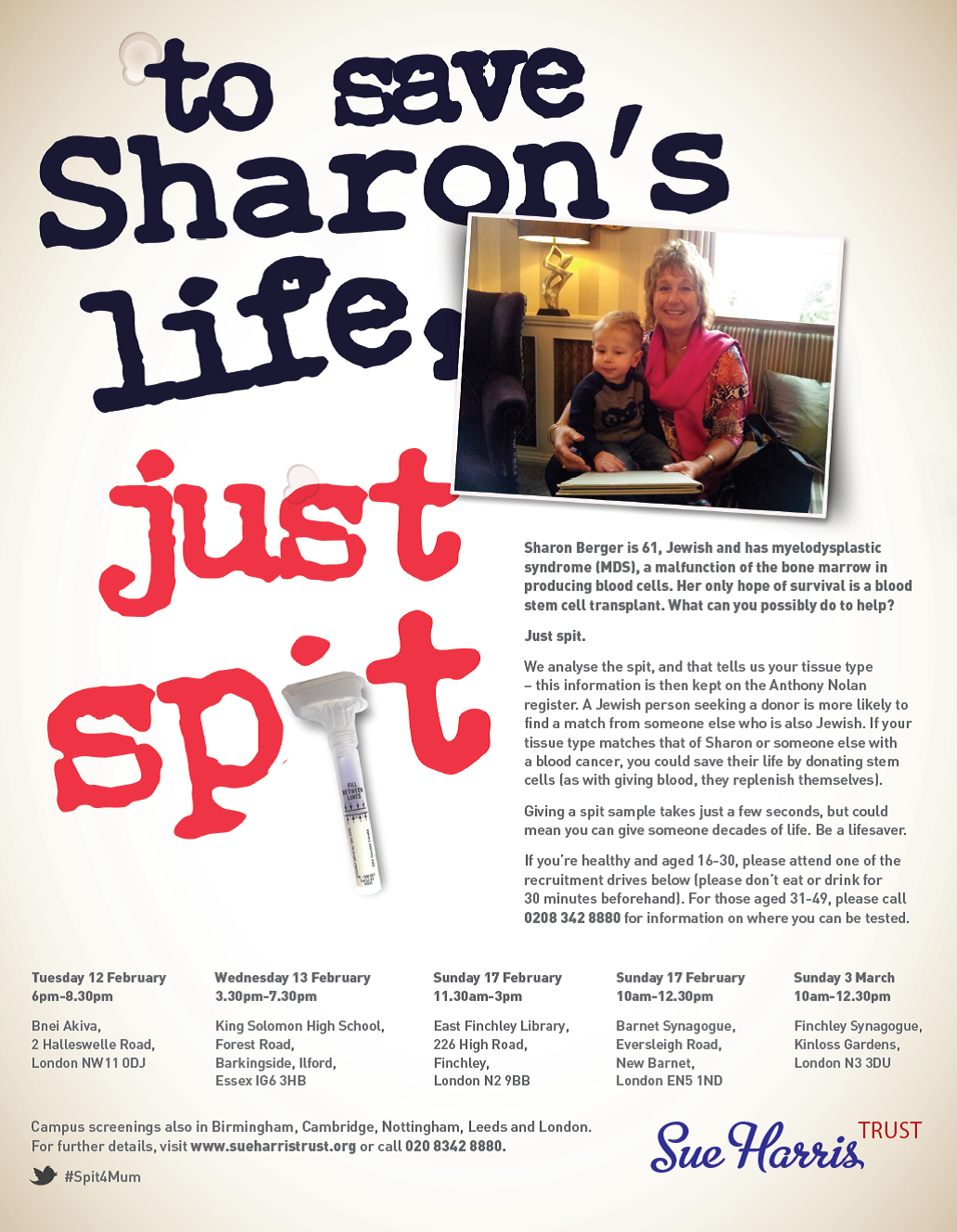
Sharon - registration times

There are also a number of screenings at schools and in different companies and locales that have been arranged already.


Update 04/03/2013

Sharon is having another round of chemotherapy – to gain a bit of time to allow for more searches for a bone marrow donor.

Many registration events are still being set up all over the world – but unfortunately – so far none that fit Sharon’s origins.

If you know people that could potentially fit the profile – do please encourage them to register – they could be the match that Sharon needs.

It is a question of weeks – not months. Please don’t delay acting on this.

MORE INFORMATION AND VIDEO CLIPS ON  STEM CELL DONATION – incl what it means for donors:

https://mdspatientsupport.org.uk/news/bone-marrow-donation/

The latest supporters of the Spit4Mum campaign: BEARDYMAN, REEPS ONE & MC ZANI BEATBOX TO SAVE A LIFE


DNA mapping for cancer

DNA mapping for cancer patients

DNA
A new project is to be launched in the UK to sequence the DNA of cancer patients and those with rare diseases.
In MDS – this will be a further improvement to better understand why certain patients respond better – or worse – to certain treatments.
BBC News article extract:

Up to 100,000 patients with cancer and rare diseases in England are to have their entire genetic code sequenced.

The Prime Minister will announce £100m has been set aside for the project over the next three to five years.

The aim is to give doctors a better understanding of patients’ genetic make-up, condition and treatment needs, and help develop new cancer treatments.

There are already a handful of targeted treatments – for breast, lung, bowel and blood cancers – where tests for a single gene can reveal whether a patient is likely to respond.

Read the full article on BBC News site here:

http://www.bbc.co.uk/news/health-20663090


Survey for patients – Jan 2012

Online survey: Improving outcomes for patients with advanced cancer

The Rarer Cancers Foundation is keen to do all it can to support the NHS in ensuring that people with rarer and less common cancers have the best experience of their care and treatment possible.  Collectively we can help to make a real difference to the outcomes for those with advanced cancer.

In order to do this, we need to learn more about the experiences of the people we support around what they value when they have advanced forms of cancer.  The feedback from your charity’s supporters is vital and we would therefore be grateful if you could please circulate the attached letter to your supporters and advertise this survey on your website. The survey can be found here

Your response is really important to us so we can have as broad a picture as possible and therefore we are seeking input from cancer patients, their family members, carers and others who have an insight in this area.

The survey will close on the 30 January 2012 and the findings from this survey and other research that we are currently undertaking for this project will be published late February/early March 2012.

Should you have any queries or need help with this survey please do not hesitate to contact me.

With best wishes

Debbie de Boltz

Executive Director

Rarer Cancers Foundation

incorporating the Rarer Cancers Forum

Mob: 07889 726269

Tel:  01227 738279

www.rarercancers.org.uk


ASH 2011 Conference Highlights

The American Society of Hematology (ASH) is the world’s largest professional society concerned with the causes and treatments of blood disorders. The mission of the Society is to further the understanding, diagnosis, treatment, and prevention of disorders affecting the blood, bone marrow, and the immunologic, haemostatic and vascular systems, by promoting research, clinical care, education, training, and advocacy in haematology. ASH attracts about 20,000 attendees every year (physicians, scientists, laboratory staff, pharmaceutical representatives).  Half of them are international visitors.  There the latest research results are presented and it is an opportunity for attendees to discuss and explain their work.

MDS Patient SupportDr Austin Kulasekararaj, Haematologist Consultant at King’s College Hospital, London kindly agreed to summarise the highlights of ASH 2011 for us.  He covered progress with existing therapies, promising trial data, new molecular mutations, as well as the revised IPSS (International Prognostic Scoring System).


MDS therapies

Combination therapy approaches both in low and high risk MDS was the focus of many presentations, building on the remarkable results obtained with 5-azacitidine and lenalidomide monotherapy.

A multicentre trial using combination therapy of 5-azacitidine (75 mg/m2 subcutaneously on days 1-5) plus lenalidomide (10 mg daily orally for 21 days out of 28 day cycle) in ‘high risk’ MDS patients showed response rate of 72%, with complete response seen in 42% and a median response duration of 16 months. The therapy was well tolerated with minimal toxicities (fever and cardiac) and significantly high response rates.

An interesting study from MD Anderson Cancer Centre assessed combination therapy of 5-azacitidine with vorinostat, a histone deactylase (HDAC) inhibitor in MDS and AML patients who were ineligible for another clinical trial or had liver or renal functions or had poor performance status. This combination was well tolerated in this ‘poor risk group’ of MDS patients with complete response rate of 26%.

Several other combination therapies of were studied in Phase 1 and Phase 2 trials, showing good tolerability and clinical activity

eg Panabinostat (HDAC inhibitor) plus 5-azacitidine,

Belinostat (HDAC inhibitor) and bortezomib (Velcade, proteosomal inhibitor)

Ezatiostat hydrochloride (Telintra) and lenalidomide (Revlimid)

Interestingly, studies using oral 5-azacitidine show good tolerability, with no drug accumulation, and promising clinical responses were observed, although these data are preliminary but the encouraging results show promise for oral azacitidine. A Phase 1 study also evaluated the safety of oral decitabine (Dacogen) in MDS patients and found to have a similar safety profile to intravenous decitabine.

A retrospective pooled analysis of MDS patients treated with lenalidomide (Revlimid) did not show a clear evidence that lenalidomide is associated with an increased risk of secondary cancers (second primary malignancies, SPMs) in lower risk MDS patients and the rate of development of SPMs was what would be expected for this age group when compared with US epidemiological database (SEER database). In another retrospective analysis of RBC transfusion-dependent patients with lower-risk MDS and del 5q, lenalidomide treatment was not associated with a higher risk of AML progression but led to a survival benefit.

Romiplostim (thrombopoietin agonists) showed an improvement in platelet count in one third of low risk MDS patients enrolled in a Phase 2 extension study, but unfortunately the trial was terminated early in view of transient increase in blast count which resolved when the drug was discontinued.

A few other selected studies presented included

  • Home administration of 5-azacitidine (Vidaza) in France – showed feasibility, higher level of patient satisfaction and safety of administration. The home administration was not associated with increased side-effects or hospitalisation.
  • Romiplostim (thrombopoietin agonists) to increase platelet counts after stem cell transplant.
  • Role of azacitidine in Lenalidomide failure in del 5q MDS patients.
  • Low dose clofarabine (5 mg/m2 vs. 7.5 mg/m2,dose finding study)-standard dose(D1 to D5) or alternate dosing (D1,D3,D5,D8 and D10), in patients failing 5-azacitidine therapy

The increased understanding of the molecular biology in MDS will help in future development of targeted therapies as the currently available therapies, although clinically effective, do not have a well-defined mechanism of action.

MDS pathogenesis

2011 has been an exciting year with the discovery of new class of molecular mutations in patients with myeloid neoplasms. The discovery of recurrent somatic mutations in RNA splicing factors in patients with MDS, especially in those with ring sideroblasts was highlighted in several presentations including the presidential symposium. Although the functional consequences of the altered splicing factors are being elucidated, this is a major breakthrough in the understanding of the pathogenesis of MDS with ring sideroblasts.

SF3B1 mutations are detected in 80-85% of patients with MDS associated with ring sideroblasts and is also present in 30% of patients with MDS overall. The mutations of the RNA splicing factors are the most common MDS-associated mutations yet to be described and these were detected as a result of whole genome/exome sequencing projects undertaken by several groups. Although SF3B1 mutations conferred a better prognosis, the prognostic impact of the other splicing factor mutations is not clear.

Prognostic models

IPSS-R

Recently, the provisional Revised International Prognostic Scoring System (IPSS-R) has been formulated for assessing the prognosis of primary MDS patients by the International working group for prognosis in MDS (IWG-PM). In this new system, as discussed by Dr.Greenberg in the MDS foundation symposium, cytogenetics remains the key stratification parameter and karyotypic abnormalities are classified into five prognostic subgroups with inclusion of more uncommon cytogenetic subsets. The depth of cytopenias was also considered and the information was obtained from 7012 patients who had not received any disease altering therapy. The IPSS-R divided MDS patients into 5 prognostic groups, with median overall survival of 8.7 years for very low risk group versus 0.8 years for the very high risk group. The value of incorporating of molecular abnormalities into the prognostic scoring systems was also debated and various groups also validated the impact of mutations on different prognostic scoring systems in MDS.

We are definitely achieving a better understanding of the mutations associated with MDS and refining risk model, but it is difficult to know just how any of these might translate into new therapies.


We thank Austin for his contribution to our scientific news.


Scientists Map Genetic Evolution Of Leukaemia Through MDS Patients

Here is a new article by the Washington University in St. Louis, School of Medicine:

This article deals with the need to develop cancer drugs that target specific gene mutations that develop in MDS.

Introduction: “By mapping the evolution of cancer cells in patients with myelodysplastic syndromes who later died of leukemia, Timothy Graubert, MD, and Matthew Walter, MD, from the Washington University in St. Louis, School of Medicine, have found clues to suggest that targeted cancer drugs should be aimed at mutations that develop early in the disease.”

Read the full article, published 14/03/2012,  here.


Scientific Updates – Articles March 2012

A selection of articles from the MDS Beacon highlighting results of recent MDS related research:


MDS on BBC1 – Hunted

Update: Response from the writer! (see below)

The BBC1 drama Hunted has featured MDS in one of their story lines – in the most recent episode Polyhedrus.

One of the side characters mentions she suffers from frequent nose bleeds and bruising – and explains it is due to a platelet disorder called MDS.

This is a very brief mention – but we are nevertheless glad to see MDS featured in a mainstream TV programme on a major channel – as it will raise some awareness of the condition.

We are trying to find out from story writer Frank Spotznitz or the BBC why they chose to feature MDS – and would like to congratulate them on having done so.  Do write into the BBC with any comments you may have as patients.

Frank Spotnitz has replied via his TV Blog:
84.At 20:03 14th Nov 2012, Frank Spotnitz wrote:  Thank you so much for all the thoughtful comments. They’re greatly appreciated. We featured MDS because it fit our storyline. I’d be delighted if the episode in some small way helps lead to a broader awareness of the condition.  Http://www.bbc.co.uk/blogs/tv/2012/10/hunted.shtml


We also wish BBC had perhaps offered support information after the programme – for anyone affected by MDS.

This is the link to the BBC I player – watch at 7:08 to 8:50 min into the episode:
http://www.bbc.co.uk/iplayer/episode/b01nvm50/Hunted_Polyhedrus/

Many thanks to our 2 patient members who called us to mention this programme.  They were quite surprised!

Please always do let us know if you spot any mention of MDS in the media – as we are not always aware of it.

MDS Patient Support


EU Petition – Research cuts – IMPORTANT – 12/11/12

This is a EU petition we ask you ALL to sign:

Requesting governments not to cut research budget for the next 7 years

DO THIS TODAY please – 12/11/12 – we only have a few days left to do this.

The budget for EU research funding for 2014-2020 (Horizon 2020) is under threat of being cut as part of the negotiations on the EU’s Multi-Annual Financial Framework at the European Council Summit of November 22-23.

Over 40 European Nobel and Fields Medal prizewinners have signed an open letter that calls upon Europe’s heads of state or governments and presidents of European institutions to save the budget for research and innovation from austerity measures. In support of this initiative an online petition is now open at:

http://www.no-cuts-on-research.eu/

The European Haematology Association (EHA ) wholeheartedly supports this initiative and is calling upon their constituency (patients and physicians) to sign.

Please sign this to make sure research funding is not cut – it is currently difficult enough as it is to find funds to research rare diseases.

We would like you (apart from signing yourself) to mobilize your friends and family constituency as well.

Email it, Facebook it, Twitter about it – ask everyone to sign it.

Print it out and ask your physicians and nurses to sign it.


MDS UK is recruiting

Following the recent departure of our assistant Alice, MDS UK will be looking for a replacement as soon as possible.  We are looking for someone with strong data analysis skills to work on our patient survey project mainly – as well as to help out in the office with daily tasks.  Good experience dealing with social media tools and websites (preferably WordPress).  This is a varied, interesting and perhaps challenging role, which also does involve contact to patients and families.

We take this opportunity to thank Alice for the time she spent at MDS UK and work she completed and wish her the best in her new role managing data in another charity.

And apologies in advance for any delay in responding to queries and letters – with reduced personnel it will be difficult to answer as promptly as before – thank you for your understanding.  We will let you know as soon as we have found a replacement.


Free donations by shopping