this must be archive.php

Get the latest on MDS Treatment from the MDS Foundation Symposium

Janet Hayden, Myeloid Clinical Nurse Specialist, from Kings College NHS Foundation Trust, London (Adapted by MDS UK Patient Support Group) brings the latest in MDS Treatment from the Annual MDS Symposium in Valencia.

MDS Foundation Symposium May 2017

Some patients are suitable for home treatment after stem-cell transplant

Many interesting projects were presented during the nursing sessions, of which three were of particular interest and relevance to myself and my professional practice.

The first presentation - 'Home Care for MDS Patients Undergoing Allogeneic Bone Marrow Transplantation', by nurse Nuria Borras - covered a project by a nurses' group in Barcelona who were already working in an established ambulatory care unit that had undertaken many autologous transplants. Three MDS patients were chosen as a pilot to receive home care after their chemotherapy and stem cell infusion. After they were all successfully discharged to home care, they were visited twice a day at home and brought to the out-patient department twice weekly. All of these patients had achieved remission with Azacitidine prior to transplant and none of the patients received Campath or ATG as part of their conditioning. It was reported that none of the patients were readmitted. It was discussed that these patients had had a good or very good performance status prior to transplant and were already very familiar with the routine of self-management and receiving out-patient care. It was concluded that careful selection of patients may be appropriate to out-patient care delivery.

Azacitidine Treatment at Home

A further very interesting project was again presented by nurses in Spain: 'Azacitidine administration at home', by Laura Muñoz Tirado.

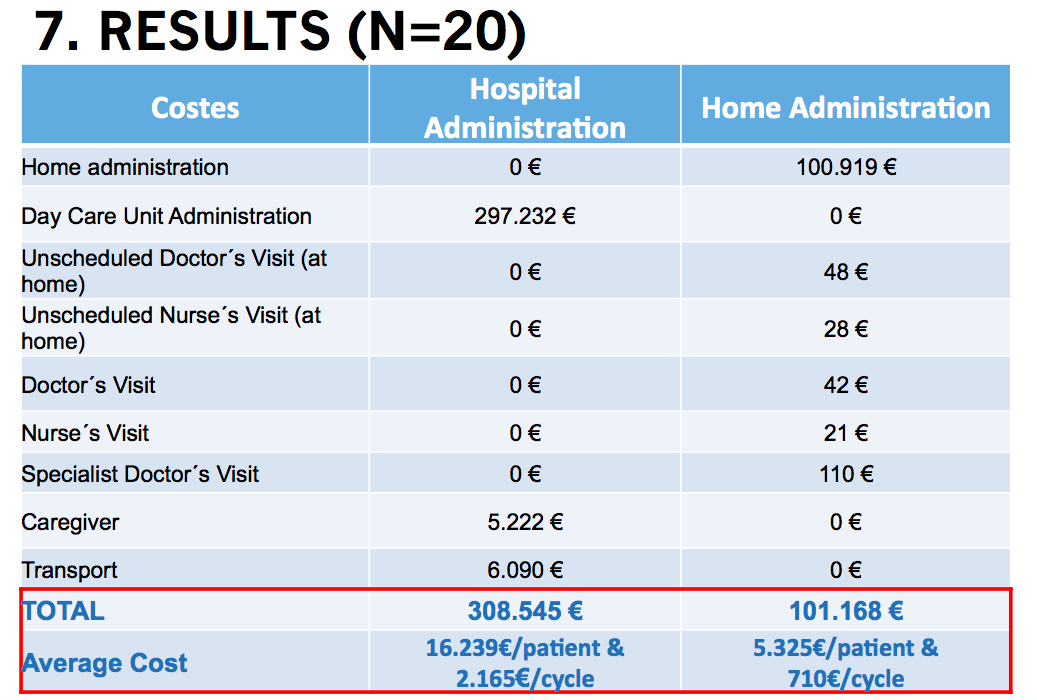
A project that has how been rolled out to include most of the hospitals in Spain administering Azacitidine, this project was undertaken across the country by nurses from home-care units. These nurses were not necessarily haematology nurses. They would visit patients at home usually by taxi from the hospital. The economic savings were shown to be vast, saving around one-third compared to hospital administration. This equated to around 100.000 euros per year per patient.

See comparison below and full presentation here.

The patient videos and reports demonstrated clearly the increased level of patient satisfaction and improved quality of life for this patient group. Discussions around this included other units adopting the practice of caregivers trained to give azacitidine at home once they had collected from the hospital on daily basis. This again showed a significant positive impact on patients who, for example, were already fatigued.

Photovoice: Patients' photos representing their MDS journey

Petra Lindroos-Kölqvist from Sweden presented Photovoice for MDS patients. This project allowed patients to take photos of things which represented their MDS journey. They were then interviewed and allowed to discuss their photos. A thematic analysis was made and themes such as hope, treatment, family and places were identified. Further work is proposed ....

See here the full presentation sent by our Swedish friend Petra and her nursing team

Managing your MDS with your Phone

As an international MDS nursing community, we rarely get the opportunity to get together and discuss our professional practice and patient care. The Nursing Leadership Board of which I am a member, facilitated some networking meetings during our stay in Valencia. In the past these meetings have produced collaborative projects and publications.

Of note and particular interest this year is that Sandy Kurtin has produced, as part of her ongoing PhD, an app for smartphones and tablets called MDS manager. The purposes of this app are to complement the already comprehensive publications of Building Blocks of Hope produced by the MDS Foundation. The app will have the capability to store MDS profile (IPSS-R scores, BM results), track bloods counts, transfusions and treatments, record symptoms, contacts of key professionals, medications, download reports, calendars for appointments and much more. Also, notifications can be sent to complete quality of life information and new clinical trials. Sandy is asking for interest to trial in centres internationally and we are looking forward to being involved in this initiative.

Other discussions and opinions revolved around looking at patient education in the light of the rapidly advancing science of MDS in identifying somatic mutations and the implications for the patients. Predominantly we discussed how we might best support patients in understanding this information and identifying the risks and benefits for them in having this information in understandable and translatable form.

As well as many excellent sessions in the scientific program, this meeting also offered a comprehensive nursing program which is described in this report.

MDS Patient Support

CNS Janet Hayden was able to attend the MDS Symposium, thanks to a generous grant from the expert group in MDS – the UK MDS Forum – to whom she is very grateful for the opportunity.

The MDS Symposium takes place every two years. In 2015, our patient group, the MDS UK Patient Support Group, sponsored travel for 2 nurses (Janet Hayden and Geke Ong) to attend the Symposium in Washington.  www.mdspatientsupport.org.uk.


Our support opportunities are open to nurses nationwide, but unfortunately it is extremely difficult for these nurses to be granted time off or study leave – due to immense work pressure as well as to hospitals being short-staffed.

We urge hospitals and managers to allow nurses to attend such conferences – as it benefits everyone in the long term. Thank you.

If you are a nurse and are interested in our offers of support, please email us on info@mdspatientsupport.org.uk


Realising the potential of haematology nurses and allied health professionals

Realising the potential of haematology nurses and allied health professionals

The Haematology Institute Nurses and Allied health Professionals Group is hosting a one day event on 10th July 2017 at the Robens Suite, 29th floor, Tower Wing, Guy’s Hospital London SE1 9RT. 

Read More


MDS UK tribute to Professor Rodney Taylor (1942-2017)

It is with immense sadness that we announce the death of our past Chairman, Professor Rodney Taylor on 3rd May 2017, after his MDS progressed to AML.

Euroblood Net

MDS UK Patient Support Group Chairman

Rodney was diagnosed with MDS in 2006 and was invited to become Deputy Chairman when our little patient group was still in its infancy.

Following the death of the then Chairman David Hall, Rodney became Chairman in 2010 and thereafter dedicated an immense amount of his spare time working for and leading the group until late 2016, when it was clear his MDS had progressed and no further treatment was possible.

Euroblood Net

Rodney's achievements for all MDS patients: NICE approval of Azacitidine

Rodney was an amazing, witty, gentle, very funny and extremely talented Chairman. MDS UK achieved an incredible amount of work under his guidance. The most significant achievement being the NICE approval of the drug Azacitidine in 2010. The MDS community as a whole owes him a huge debt of gratitude for this work which spanned 2 years.

You can read more about Rodney and his amazing career here: https://mdspatientsupport.org.uk/members/prof-rodney-taylor

During his time as Chairman, Rodney met with all stakeholders in the medical and pharmaceutical MDS sector and was immensely appreciated, liked and respected for his views, understanding, advice and personality across all professional and patient groups alike.

Euroblood Net
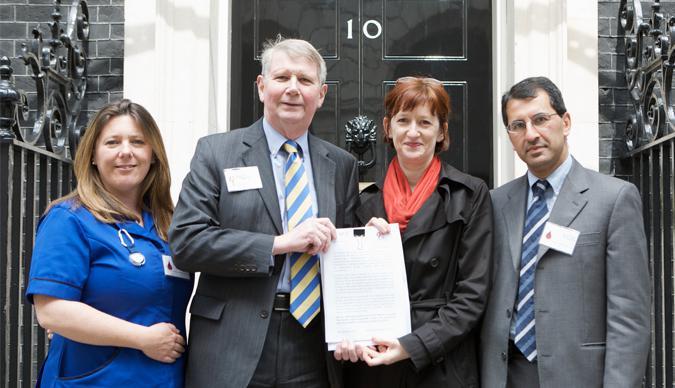
Professor Rodney Taylor with an MDS Campaigner

Passionate about a good doctor-patient communication

Rodney had two topics he was particularly passionate about resulting from his being a medical doctor as well as a patient.

The first topic was the Doctor/Patient actual communication – as to him this was absolute key to a good consultation, relationship and care overall.
Rodney taught about this and one of his wishes was to re-instate regular courses for physicians about Advanced Communication Skills.
He knew this was a skill that can be improved – and could immensely assist clinicians and therefore also patients – especially in today’s stretched NHS.

MDS Patient Support

Rodney's passion for Quality of Life for MDS patients

The second topic was equally close to his heart – Quality of Life (QOL) for patients. The fact that survival is not always the ultimate aim and that patients’ wishes, desires and situations can differ greatly and need to be respected at all times. Rodney believed that QOL must be measured and assessed on a regular basis at every point in a patient’s life – from diagnosis to death – and acted upon. Rodney believed totally in the QOL of MDS patients and followed his belief in his own treatment.

MDS Patient Support

Rodney was treated with Azacitidine for almost 5 years before undergoing a stem cell transplant at age 71. Three years after the transplant his QOL of life had deteriorated and he did not wish to undergo any further experimental treatments that would have meant more intensive hospital care.

Despite a few serious side-effects over the course of those three years, Rodney carried on working with the CEO and the new Chair until the last few weeks of his life. He continued to give valuable advice, opinions and views on the way ahead for MDS UK, which was much appreciated and extremely helpful to the incoming Chair. His thoughts and views were always given in his caring, considerate style – and his lovely sense of humour.

Euroblood Net
Euroblood Net
Euroblood Net

In Rodney Taylor's Memory

We at MDS UK have grown, learnt and improved thanks to Rodney’s leadership. His death is an immense loss to us. We will maintain our work and dedication to patient support and services – emphasising QOL and good communication at every opportunity - in his memory.

MDS UK was extremely important to him and the work we did was very close to his heart – and so were all the committee members and patients. He cared very deeply – and never missed an opportunity to express it. Equally – Rodney was very close to our heart too.

Rodney had not made his wishes known to MDS UK whilst alive, but he had arranged to have memorial donations directed to our organisation as an option.

We have therefore set up a page in his memory – where you can also leave a message which will be read by all family and friends:
http://uk.virginmoneygiving.com/SomeoneSpecial/RodneyTaylor

His death comes shortly after that of a previous MDS UK Committee Member, Sharon Berger, who passed away due to similar reasons, after a second transplant.

With the increased research being conducted into MDS we all hope, as Rodney did, that a real cure or at least improved treatments, are on the way for patients.

We thank all the friends, colleagues and patients who have sent in tributes and caring thoughts regarding Rodney. We are very grateful and will pass them on to his family.

We offer our most sincere and caring condolences to his wife Janet, to his children Alice, Beatrice and Romilly and to his many grand-children.

Rodney was a man of deep faith and quiet conviction. There is a Native American saying which says "when you were born you cried and the world rejoiced. Live your life so that when you die the world cries and you rejoice”. Rodney certainly lived his life well and I am sure has received a very warm welcome in heaven. May he rest in peace.

If you wish to leave a few words about Rodney, or a comment, tribute, thought – please email us on mds-uk@mds-foundation.org – with the Subject: In memory of Rodney.

We will then publish your comments on this page – with your name (if you wish), or anonymously if you prefer.

Very many thanks in advance.


MDS Treatment: What to Expect from a Visit to a Consultant

Dr. Christopher Dalley & Dr. Timothy Chevassut – Haematologists at Brighton and Sussex University Hospitals Trust and Royal Sussex Hospital NHS Trust - give an account of how they discuss diagnosis and treatment with their MDS patients. Watch the video and read the transcript below.

What are the typical issues when you first diagnose a patient with MDS and when may you tell patients about the existence of a support group?

I think it's really difficult sometimes for patients to understand what goes on in the blood. So, for me, it's really important to try to give an appropriate explanation about what myelodysplasia is and the symptoms they may have. Of course, because it is a significant blood disorder with lots of anxiety, you want to be able to support the patient when you give the diagnosis and try to allay any anxieties that they may have.

In terms of the diagnosis and explaining the diagnosis, there's lots of written information available, so it's very important for patients to access that (and I often give that to patients at first diagnosis or subsequent visits) and also to be able to access support from the MDS Patients Forum. So normally I give that information at the time of diagnosis, and a clinical nurse specialist who I work closely with will also reiterate that to patients.

And how have you seen the Patient Support Group activities and materials help specific patients?

Well, a lot of patients have questions and I think, in this day and age, most patients want to have information that they can access and it's not always the case that you can access that information in the clinic or have all the questions answered in the clinic, to be honest. So I find that if they have additional support they can access that information, talk to other patients and experts and to other family members from across the UK. I think that's really important and a great help for patients and families.

Tim, how frequently do you discuss clinical trials with your MDS patients and have you heard of any trials today that sound interesting or promising?

We discuss clinical trials as and when it's appropriate to do so. Obviously, we have established treatments by way of Azacitidine for patients newly diagnosed with high-risk myelodysplasia but, of course, not all patients respond to those treatments. Some will progress to leukaemia, others won't have an adequate response in terms of their blood count. So there are many occasions when we have to look at alternative treatments for these patients and that really would be the occasion for bringing up clinical trial opportunities both within Brighton and elsewhere, for instance at Kings or elsewhere in London.

And what kind of difficulties do you encounter with explaining the concept of trials to patients? Have you got an example of a really successful trial for a patient?

I think the concept of clinical trials and the problems perhaps we encounter when we discuss these with patients are conveying the sort of complexity of the study in simple terms that they're able to get their head round. These are often very complicated trials with a lot of patient information with them. But, in essence, the question that all clinical trials are trying to answer is whether new treatments that are becoming available for us are better than standard treatment. For most of the patients who fail Azacitidine, there really isn't any "Plan B", so we are very keen to try and understand where these newer therapies will fit in future treatment for our patients.

You asked about clinical trials that we have ongoing in Brighton at the moment: we're looking at antibody-based therapies, at targeted therapies; we're looking at Immune Checkpoint Inhibitor therapy which is very promising in the solid tumour field, but not yet established in blood cancers; we're looking at antisense therapy, hopefully next year, in patients who have refractory anaemia or anaemia that's no longer responding to Erythropoietin, for instance.

So we have some interesting trials locally and obviously many others elsewhere in the country. The important thing is giving patients the opportunity to take part in these studies and make these studies available to them.


Second Opinions are Welcomed says Dr. Simone Green

How is a patient's treatment discussed and managed?

Sophie Wintrich, Chief Executive of the MDS UK Patient Support Group, interviewed Dr. Simone Green – Haematologist at Hull and East Yorkshire Hospitals, NHS Trust. Watch the video and read the transcript below.

What are the benefits of patients’ groups? What difference does it make to you personally, in your daily consultations, to have a well-informed or empowered patient?

I think these patients tend to be more involved in their ongoing care. They come to the consultation with information and it makes the consultation flow much easier. They know what they want out of their management, they know what they want for their long-term care. It just makes the consultation easier when you need to discuss the diagnosis, the prognosis, etc.

Are there any drawbacks to having a patient who is “over-informed”?

It always good for patients to be informed. But we sometimes encounter difficulties when a patient becomes disappointed when a new drug, for example, is not available to them in their centre. With MDS there are new drugs coming out, most of them available in clinical trial studies only. So, if a study is not available at their centre or somewhere that is easily accessible, it’s disappointing for the patient. That’s one difficulty.

One topic that comes up very often in our patients’ calls is second, or what we call 'additional', opinions. What are your views on patients who request an additional opinion? Does it offend you if a patient asks for an additional opinion when he is seen by you?

One of the reasons that I went into haematology is that we work as a team - there is no individualised treatment, the treatment is all evidence based and we work as a team managing our patients. I welcome a second opinion, it’s always good to have fresh eyes, bringing a new perspective on how to manage a patient. It involves someone else’s expertise.

What is the difference for patients between being discussed in an MDT1 and going for an additional opinion somewhere else, as you have just explained?

An MDT involves decision making within a local team, or a local network in some situations. So obviously that will take into account the local guidelines, which are evidence based, but it will be tailored to that local environment. It looks at the local resources available and the local expertise as well - so the clinical experience within that centre. A second opinion will be outside of that local setting, taking into account someone else’s experience and expertise, and probably it would have a perspective based on a lot more information and more resources.

1 A Multidisciplinary Team (MDT) is a group of health care workers and social care professionals who are experts in different areas with different professional backgrounds, united as a team for planning and implementing treatment programs for complex medical conditions.

"Well-informed patients tend to be more involved in their daily care. They come to the consultation with information and it makes the consultation flow much easier. They know what they want out of their management, they know what they want for their long-term care..." Dr. Simone Green


Sharon Berger, one of the founders of MDS Patient Group, a campaigner and a friend

We are deeply saddened by the news that Sharon Berger passed away a few days ago. Sharon was one of the founders of the very original MDS patient group back in 2007, when that group was still in its infancy - together with Fiona Pirilla and Kes Grant.

Euroblood Net

MDS UK Patient Support Group Treasurer

In 2008 and thereafter, when the group grew, thanks to the help and advice of the MDS Foundation, the financial support of Novartis and Celgene (and their very dedicated patient relation staff members) and the great leadership of chairman and MDS patient David Hall, Sharon became the treasurer of MDS UK, later together with her husband Stephen, until they resigned a few years later, due to Sharon's MDS progressing to AML.

MDS UK is very grateful to the time and work both Sharon and Stephen contributed over the years to the organisation.
All members who got to know them over the years, working and growing together as a group are deeply saddened and convey their condolences to the family.

Recruiting stem cell donors of Jewish origin: the great legacy of Sharon

The MDS and AML community owe a huge debt of gratitude to the Berger family who took on the extraordinary task of recruiting stem cell donors of Jewish origin, when Sharon's needed her first transplant.

Sharon had a very rare and mixed ethnic background of Russian and Ashkenazi Jewish origin, which meant a very long and difficult search for a suitable donor.

Her children Jonni and Caroline created an incredible campaign to mobilise the Jewish community to register as donors.

It grew the percentage of Jewish stem cell donors by over a 1000% and did finally result in finding a donor.

The work of Caroline and Jonni are an inspiration to all patients, organisations and haematologists, as to what can be achieved when everyone works together.

Their efforts had a huge impact everywhere and are a tribute to their Mum, who went through so much, but always brave, strong and positive.
We convey our sincere condolences to Jonni, Caroline, Stephen, Sharon's sister and all the family and many friends.

http://jewishnews.timesofisrael.com/sharon-berger-loses-leukaemia-battle/


“One of the biggest challenges for a patient is they’ve never heard of MDS” says Prof David Bowen

In the first video of this series, Prof. David Bowen – Consultant Haematologist at St James University Hospital, Leeds talks to Sophie Wintrich, Chief Executive of the MDS UK Patient Support Group, about how important it is to be a well-informed patient. Watch the video and read the excerpts below.

What are the typical issues when you first diagnose a patient with MDS?

What difference does it make to you personally - in your daily consultations – to have a well-informed or empowered patient? Benefits/drawbacks?

"If the patient has some idea about what MDS is and they come with a set of questions from their own readings, that is a useful framework to find the details that are specific to them.
I usually use the MDS Patients Support Booklet... I mark the booklet and the sections that are relevant to them..." Prof. David Bowen

How important is it to have a treatment plan for MDS? Why?

How do you address and explore quality of life issues with patients and their families?


A New European Network, EuroBloodNet, will ensure better care for MDS patients

Patients with rare blood disorders will benefit from networks of excellence across Europe

EuroBloodNet was launched at the third conference on European Reference Networks (ERNs) yesterday in Vilnius, Lithuania

Euroblood Net

European Reference Networks (ERN) is an initiative of the European Commission and consists of networks of healthcare providers and centres of excellence across Europe aimed at improving quality, safety, and access to highly specialised healthcare.

Through these networks, healthcare providers have access to a much larger knowledge pool and patients have better chances of receiving the best treatment.

EuroBloodNet, the European Reference Network for rare hematological diseases, brings together 66 highly specialized hospital centres with expertise on malignant and non-malignant rare blood diseases.

MDS Patients are represented

Patient involvement is key, so the haematology patient community elected five representatives for EuroBloodNet. Sophie Wintrich, from the MDS UK Patient Support Group, is among them, to ensure that the patient voice is fully represented.

This is a great achievement and a proof that the role of patients is increasingly recognised in clinical care.

After their first meeting in January 2017 in Paris, EuroBloodNet will gather again at the Congress of the European Hematology Association, between 22-25 June, in Madrid, Spain.


Personalised Treatment for MDS Patients: Not Far-Off says Dr Catherine Cargo

Where are we exactly with respect to personalised treatment for MDS patients?

Sophie Wintrich, Chief Executive of MDS Patients Support Group interviewed Dr Catherine Cargo – Consultant Haematologist at St James University Hospital – Leeds. Watch the video and read the transcript below.

MDS: A disease where everybody is different

When we think about personalised treatment we think about a disease where everybody is different. We group all these patients together, but everybody’s disease has slightly different changes in the genetic make-up of the disease and also how they progress or how they do in the duration of their disease.

The really interesting thing about where we are with MDS now is that we will hopefully be able to personalise treatment for the patient so we can look at the patient - look at their individual disease and what abnormalities they have - and then potentially target those abnormalities with specific drugs.

"We are starting to see particular drugs which target specific abnormalities"

I think that it is an exciting time, because we are now starting to see particular drugs which target abnormalities or genetic mutations which are found in MDS and certain patients will respond very well to those.

Another interesting thing is that we can use technologies to identify patients who will respond to more generic drugs - drugs that we at the minute give to everybody. There will be certain patients who will respond very well to those and we should be able to use a lot of these new technologies to identify patients who will respond better, and give patients an idea of how they are going to do on treatment and what their future holds.

Does it mean that all patients must have genetic mutation test?

Q: Does that mean we should start to insist that all patients must have genetic mutation tests to establish which treatments may work out best for them?

I think we are getting to the point where this information is going to be useful in the clinic. We are still gathering information and the tests that we use are still quite difficult and quite complicated for a lot of different labs. And at the minute we don’t have a very standardized way of doing this, so there is quite a lot of work that needs to be done before we get to the point where we can offer this as a blanket test for everybody. I think we will get there and it is something that we will do in the future. It is an option, we can do it in the UK. It’s exciting and I think it will be offered in future, but we shouldn't necessarily be insisting on it now. There are certain cases where it will be particularly helpful and it’s definitely being applied in the clinical trial setting. It will be very interesting gathering that information. At some point in the future we will be able to insist that patients do get this testing done.

Q: How far off is this future?
I don’t think that it is that far off. This is something that we are going to be doing quite soon. The technology is there. It’s becoming cheaper and cheaper to do, and it’s becoming easier to do, even within the NHS. So I think within the next couple of years we will be seeing this as a routine test for MDS patients.


2nd Stem Cell Transplants Funding Re-instated Thanks to Your Support!

NHS England will fund 2nd stem cell transplants for patients whose blood cancer relapses

Since NHS England initially announced in December 2016 that it wouldn’t fund second transplants, more than 25,000 people joined our campaign to reverse the decision.

Thanks to every single person that signed the petitions, and wrote to their MPs. We all did it together.

Thanks to colleagues at Anthony Nolan, all other blood cancer charities, Emma Paine, Mark Tami MP, the APPG on Stem Cell Transplant, many MPs and clinicians, Sasha Jones and friends.

An extra-special thanks to the Hepburn family, who showed so much courage and campaigned selflessly after Gavin's death. We owe them a huge debt of gratitude.

Second Stem Cells Transplant Campaign

NHS Announcement in detail: routine funding for 2nd stem cell transplants for patients who relapse more than a year after their 1st transplant

On Friday 24 February NHS England announced that they will routinely fund second stem cell transplants for patients who relapse more than one year after their first transplant. This replaces the announcement in December 2016 that second stem cell transplants were ‘not currently affordable’.

Every year, a small number of patients with a blood cancer or blood disorder who have already received one stem cell transplant from a donor will unfortunately relapse (their disease will come back). For some of these patients, their doctor might recommend a second donor stem cell transplant. It is estimated that 16 to 20 people every year in England will need a second transplant because their blood cancer or blood disorder has relapsed.

This decision affects a small number of patients in England who:
• have received a first donor (allogenic) stem cell transplant;
• were in complete remission;
• subsequently relapsed more than 12 months after their first transplant; and
• their doctor now recommends a second stem cell transplant.

This decision does not affect patients who suffer graft failure (their first transplant fails) or patients who have received a first transplant using their own cells (autologous). This decision only affects patients in England; patients in other parts of the UK are not affected.

Why does this decision only apply to patients who relapsed more than 12 months after their first transplant?

The recommendation of clinical experts is that patients who relapse more than 12 months after their first transplant have the best chance of a successful second transplant. Unfortunately, there is weak evidence for the effectiveness of second transplants for patients who relapse within a year of their first donor transplant.

Read More: Blood and Marrow Transplantation

Join the Register!


Free donations by shopping