this must be archive.php

Thanks to our fundraisers, a new MDS Quality of Life study is possible

At MDS UK, our work is made possible by our community. Thanks to two generous, community-funded contributions, we are now able to support a new study focused on improving quality of life (QoL) for people living with Myelodysplastic Syndromes (MDS). We are hugely grateful to both groups for making this project possible.


About the MDS Quality of Life (QoL) Study

Led by Health Psychologist and Doctoral Researcher, Stacie Thursby, the study will be looking at ways to improve everyday quality of life for those living with MDS.
The research will examine what it really means to live with MDS and aims to develop practical, evidence-based tools for use in daily life. The patient voice and lived experience will be central to every aspect of the study, ensuring any proposed solutions truly reflect the needs of MDS patients. More details of the study will be announced soon.  

Our sincere thanks to Buckby Castle Masonic Lodge


Our first major contribution comes from Buckby Castle Masonic Lodge, whose members raised £2,500 by completing a sponsored walk along Hadrian’s Wall.
The members walked in memory of Worshipful Brother Yan Pheonix’s father, Douglas. Their dedication and personal commitment to honouring Douglas’ memory — alongside their ongoing support for Yan, Marlene and his family — has directly contributed to the launch of this Quality of Life (QoL) study.


MDS UK CEO, Blossom Bell, accepting cheque for £2500 from two members of Buckby Castle Lodge
Pictured (L–R) Brother Chris Long, Dr Blossom Bell (CEO, MDS UK), and Worshipful Brother Yan Pheonix

A heartfelt thank you to The Stragglers running club


The second generous contribution comes from our longstanding partnership with the Cabbage Patch 10, an iconic 10-mile race organised by The Stragglers Running club — a club well known for its strong community ethos and commitment to supporting local charities.
Through their 2025 event, The Stragglers donated £2,500 to MDS UK.
We are deeply grateful to The Stragglers for continuing to choose us as one of the charities supported by the event, and for the warm, inclusive community they foster around the race.
Event organiser Kevin Price, pictured with MDS UK Patron Caitlin Limmer, has confirmed their intention to continue the partnership in future years — something that means a great deal to us.
To everyone who ran, organised, volunteered or cheered from the sidelines: thank you. Your miles have helped move MDS research forward.
Cabbage Patch 10 event organiser Kevin Price, pictured with MDS UK Patron Caitlin Limmer, from the Stragglers Running Club
Cabbage Patch 10 race organiser Kevin Price, with MDS UK Patron Caitlin Limmer


What your support means for people living with MDS

Together, these two donations have allowed us to move forward with a research programme focused on improving day-to-day life for people living with Myelodysplastic Syndromes.
Quality of life is about more than treatment. It’s about having the energy to get through the day, maintaining independence, feeling confident, and knowing your voice is heard. It’s about practical support that makes everyday challenges more manageable.
Because of your fundraising, this work is now underway.
On behalf of everyone at MDS UK — and the patients whose experiences will help shape this study — thank you. We look forward to sharing more with you soon.
 

If you would like to help us fund more research and trials like this please consider donating either a single amount or a small monthly donation by clicking the button below.


Understanding stem cell therapy for MDS

In this presentation, Patricia Cardoso, Bone Marrow Transplant Coordinator and Clinical Nurse Specialist (CNS) at King’s College Hospital, London, explains what to expect before, during, and after a donor stem cell transplant. The session covers donor selection, transplant preparation, chemotherapy, recovery, side effects, and long-term follow-up.

Watch the presentation 

This session was recorded for MDS UK Patient Support Group  - February 2026.

Download the pdf 


Click or tap the thumbnail image to download a pdf of Patricia Cardoso's presentation 'Understanding Stem Cell Therapy'

About Patricia Cardoso

Patricia Cardoso, Bone Marrow Transplant Coordinator and Clinical Nurse Specialist (CNS) at King’s College Hospital, London
Patricia Cardoso is a Haematology Nurse with over 10 years’ experience in cancer care and a long-standing commitment to supporting people with blood disorders. She currently works as a Bone Marrow Transplant Coordinator and Clinical Nurse Specialist (CNS) at King’s College Hospital, where she coordinates complex donor stem cell transplants and supports patients and families throughout the transplant journey.
Her work spans from transplant preparation through treatment and recovery, with a focus on helping patients feel informed, supported, and confident during this critical stage of their care.

Downloadable booklets about stem cell transplants


Patricia mentioned a number of booklets in her presentation, which we’ve listed below. Click or tap the links or booklet images to download a PDF copy.
  • Blood stem cell and bone marrow transplants: The seven steps This booklet is for people who are going to have a stem cell transplant, and for those supporting them. It explains the transplant process in clear, step-by-step stages, helping you understand what lies ahead and how each stage supports your recovery.

(If you’d prefer a printed copy, you can order one free of charge from the Blood Cancer UK online shop. Free delivery is available for information booklets.)

If you’d prefer a printed copy, you can contact: Anthony Nolan patient support via patientinfo@anthonynolan.org


Further information and resources from MDS UK


  • Download our comprehensive MDS Patient Guide for clear, reliable information about living with MDS and understanding your diagnosis.


  • You don’t have to face MDS alone — explore our Support section for practical advice and emotional support via our support line and virtual meetings.

New PyramIDH clinical trial for MDS with IDH1-mutation now recruiting in the UK

New PyramIDH clinical trial for MDS with IDH1-mutation now recruiting in the UK

About the PyramIDH trial

PyramIDH is the name of a randomised clinical study designed to measure the efficacy of Ivosidenib, an oral inhibitor which specifically targets the gene mutation IDH1, compared with the commonly used hypomethylating agent (HMA) Azacitidine (often referred to as Aza).   


Why this study matters

Following promising results from phase 2 of the study, which showed a 72% overall response rate for Ivosidenib (as a monotherapy, or single treatment) in patients with previously untreated  IDH1-mutant MDS,  the aim of this third phase is to further validate the findings by testing a wider cohort of patients.   


Trial design

The trial managers are looking to recruit approximately 48 MDS patients with the IDH-1 mutation who have not previously been treated with hypomethylating agents.  They will be split randomly into two groups, with the patients in one group to be treated with Ivosidenib and the other group Azacitidine.   


Who can take part?

You may be eligible if:
  • You are 18 or older and have been diagnosed with MDS with the genetic mutation IDH-1
  • You have not yet been treated with hypomethylating agents
  • You live within reasonable travelling distance of one of the trial centres listed below

Considering this trial?


If this trial is of interest to you and you think you may be eligible, discuss it with your consultant. Your consultant can assess whether the trial is suitable for you and how it fits with your current care.

UK trial sites and contacts

  • Churchill Hospital, Oxford – Contact: Dr Connor Sweeney
  • King’s College Hospital, London – Contact: Dr Lynn Quek
  • University College Hospital, London - Dr Rob Sellar
  • Western General Hospital, Edinburgh – Contact: Dr Victoria Campbell
  • Torbay Hospital, Torbay – Contact: Dr Zhao Rui

Full trial details on the official ClinicalTrials.gov listing


  • You can view full trial details, including eligibility criteria, trial sites and study design, on the official ClinicalTrials.gov listing: clinicaltrails.gov


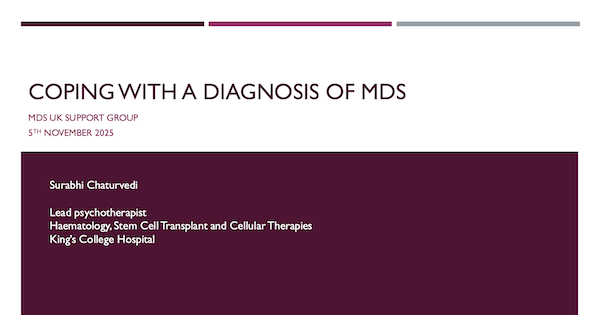
‘Coping with an MDS Diagnosis’ – Presentation by Senior Psychotherapist Surabhi Chaturvedi

In this presentation, 'Coping with an MDS diagnosis', lead Psychotherapist Surabhi Chaturvedi from the haematology department at King’s College Hospital, London, discusses the emotional challenges of an MDS diagnosis and offers practical, evidence-based coping strategies for patients, families & carers.

Watch the presentation 

This session was recorded for MDS UK Patient Support Group  - November 2025.

Download a pdf of the presentation


Click or tap the thumbnail image to download a pdf of Surabhi Chaturvedi's presentation 'Coping with a diagnosis of MDS'

About Surabhi Chaturvedi

Lead Psychotherapist Surabhi Chaturvedi in the haematology department of King's College Hospital, London
Surabhi Chaturvedi is the senior psychotherapist and service lead for the Haemato-Oncology psychological support team at King’s College Hospital. An integrative psychotherapist with a background in clinical psychology, she leads a team of psychological therapists within the hospital’s Haematology, Stem Cell Transplant, and Cellular Therapies unit, providing specialist psychological support to patients and families affected by blood cancers and bone marrow failure, and delivering training on the psychological care of Haematology patients.

Resources & services - where to get help


Support from MDS UK


Apps, websites & services
Surahbi mentioned various resources that can support you and we've added some too.


Services
    • NHS Talking therapies  offers free, self-referrable mental health support for anyone struggling with anxiety, depression, or everyday emotional difficulties.
    • Maggie's offers free, compassionate cancer support both in person and online, providing a welcoming space to talk, seek guidance, and feel understood.
Apps
    • Calm  An app to help you manage stress and anxiety, get better sleep, and feel more present in your life.
    • Headspace  An app to offering evidence-based meditation and mindfulness tools, to help you create life-changing habits to support your mental health.
Web articles
Books / Audio guides
    • Jon Kabat-Zinn - Full Catastrophe Living -Jon Kabat-Zinn’s Full Catastrophe Living is a classic guide to mindfulness-based stress reduction, offering practical ways to use mindfulness to cope with stress, pain, and illness. Kabat-Zinn, the founder of Mindfulness-Based Stress Reduction (MBSR), draws on his background in integrative medicine and his decades of experience in meditation and healthcare to show how mind–body practices can support healing. This seminal book is also available as an audiobook.
    • Jon Kabat-Zinn - website. Resources, teachings, and talks from the creator of Mindfulness-Based Stress Reduction, offering insight into mindfulness and healing.

Further information and resources from MDS UK


  • You can download our comprehensive MDS Patient Guide for clear, reliable information about living with MDS and understanding your diagnosis.
  • You don’t have to face MDS alone — explore our Support section for practical advice and emotional support via our support line and virtual meetings.

Free NHS App for blood transfusion patients

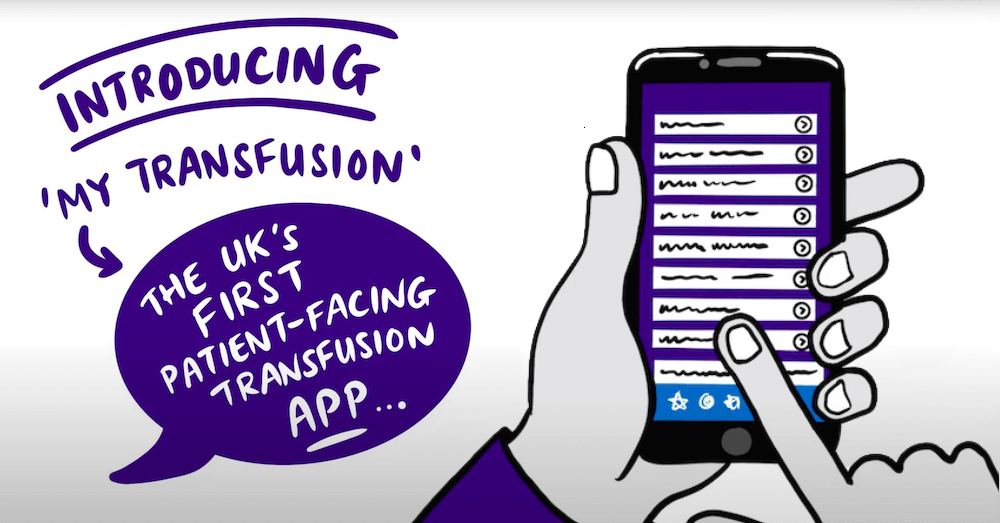
Illustration of hands holding a phone displaying the NHS My Transfusion app with the text ‘Introducing My Transfusion’.”
A new NHS-supported app, My Transfusion, has been launched to help people who receive blood transfusions better understand their treatment.


Who the app is for

It's designed for patientscarerstheir families, or anyone involved in supporting someone undergoing a blood transfusion. It may also be a useful source of information for health care staff involved in the transfusion consent and decision-making process.  

Aim of the app

Developed by the team at SHOT (Serious Hazards of Transfusion), the My Transfusion app aims to improve patient understanding, support informed choices, and enhance safety in transfusion practice.

What the My Transfusion app offers

The app provides clear, reliable information about every stage of the transfusion process, including:
  • Key information about blood transfusions
  • Other available options in place of transfusion
  • How to prepare for a transfusion and what consent involves
  • Understanding blood components and receiving blood best suited to you
  • Safety checks before transfusion and recognising acute transfusion reactions
  • Post-transfusion advice
Whether you are new to transfusions or have received them before, the app helps you feel more informed, confident, and involved in your care.

Resources for healthcare professionals


Download the app for free on all major platforms

The My Transfusion app is completely free. The easiest way to download it is to scan the barcodes below with your mobile phone using your camera function.
QR code linking to the My Transfusion app download page on the Google Play store and the Apple App Store.
If you prefer not to use the QR codes, just go to the Google Play Store or Apple App Store and search for ‘My Transfusion'.

Other ways of accessing the app


More information about transfusions on MDS UK


Blood transfusions explained : by Kelly Nwankiti, Lead Nurse at King’s College Hospital

We’re pleased to share this presentation Understanding Blood Transfusions from Nurse Kelly Nwankiti, Lead Nurse for Patient Blood Management at King’s College Hospital. Kelly explains the key details of blood transfusions — including who they’re for, why they’re needed, and what’s involved in the process. She also answers important questions from patients, helping to make this complex topic clearer and easier to understand.
Watch the video below to learn more.

Watch the presentation

"Understanding Blood Transfusions" – by Nurse Kelly Nwankiti | MDS UK

(Recorded at an MDS UK online support meeting, October 2025)

About Nurse Kelly Nwankiti

Kelly Nwankiti, Lead Nurse for Patient Blood Management at King's College Hospital
Kelly Nwankiti is the Lead Nurse for Transfusion and Patient Blood Management at King’s College Hospital, London.
In this role, she oversees transfusion services and leads initiatives to improve patient blood management. She is an active member of the British Society of Haematology’s Transfusion Task Force, contributing to national discussions and best practices in the field.
Kelly has presented widely on topics related to blood management and transfusion care, and her work has been recognised for advancing clinical standards. She has also co-authored research, including studies examining prehospital transfusion in paediatric trauma.


Download NHS Patient Information leaflet about Blood Transfusions 


Follow this link to the NHS Patient Information Leaflet Receiving a Blood Transfusion mentioned by Nurse Kelly Nwankiti in her video presentation.


More information

  • To learn more about how blood transfusions are used to manage anaemia in people with MDS, and to hear insights from Dr Matt Poynton, visit our dedicated page on Blood, or Red Cell, Transfusions.

  • Find out more below about the free NHS app for blood transfusion patients.

Free NHS App for Blood Transfusion Patients

Illustration showing hands holding a mobile phone with the My Transfusion app on screen, with the text ‘Introducing My Transfusion’
My Transfusion is a new NHS-supported app created by SHOT (Serious Hazards of Transfusion) to help patients and carers better understand blood transfusions and feel more confident in their care.
 

MDS World Awareness Day October 25th – 2025

Red awareness graphic reading “MDS World Awareness Day, October 25 2025” with the MDS UK web address www.mdspatientsupport.org.uk/spot-mds-symptoms  promoting the Spot the Symptoms campaign
Every year on October 25, we join the global MDS community to mark MDS World Awareness Day — a day dedicated to raising awareness of myelodysplastic syndromes (MDS), a rare blood cancer that often goes unrecognised.

Spot the Symptoms -  #BrusingBleedingFatigue

This year, our focus is on helping people spot the symptoms of MDS — a condition that’s often missed or mistaken for other health problems. Subtle changes such as persistent tiredness, easy bruising, or breathlessness after light activity shouldn’t be ignored. By recognising these signs and asking your GP for a Full Blood Count (FBC), more people can receive the right diagnosis, support, and treatment sooner.

Fatigue and Anaemia


MDS Patient Support
Feeling unusually tired, weak, or lacking energy is one of the most common signs of MDS. This fatigue is often caused by anaemia, when the body doesn’t produce enough healthy red blood cells to carry oxygen around the body.
People may experience:
  • Persistent tiredness even after rest or sleep
  • Difficulty concentrating
  • Dizziness or light-headedness
  • Muscle weakness
  • Pale skin
These symptoms are often mistaken for normal ageing, stress, or other conditions — but if they persist, speak to your GP and ask for a Full Blood Count to rule out MDS.

Easy Bruising and Bleeding


MDS Patient Support
Bruising or bleeding more easily than usual can be an early warning sign of MDS. This happens when platelets — the blood cells that help with clotting — are too low (a condition called thrombocytopenia).
You may notice:
  • Frequent or unexplained bruises
  • Bleeding gums or nosebleeds
  • Heavy or prolonged bleeding from small cuts
  • Tiny red or purple spots under the skin (petechiae)
If you notice these symptoms, speak to your GP and ask for a Full Blood Count. This simple test can quickly check your platelet levels and show whether you need a referral to a haematologist.

Breathlessness and Shortness of Breath


Feeling breathless after minimal exertion — climbing stairs, walking a short distance, or even talking — can also indicate anaemia related to MDS. With fewer red blood cells, less oxygen reaches the body’s tissues, causing breathlessness even with mild activity.
People may also experience:
  • Heart palpitations or racing heartbeat
  • Chest discomfort
  • Feeling faint or dizzy when standing
If breathlessness seems out of proportion to your activity level or age, speak to your GP and ask for a Full Blood Count. This quick test can identify low haemoglobin levels and show whether further investigations are needed
European Haematology Association (EHA) Conference 2025 in Milan – event banner

If you spot the symptoms, ask your GP for a Full Blood Count.

A Full Blood Count (FBC) is a simple blood test your GP can arrange to check for signs of MDS. It’s a routine test that measures red and white blood cells and platelets, and can quickly show whether further investigation into MDS is needed.


Complete Blood Count test

Why raising awareness matters

MDS is still widely under-recognised, often misdiagnosed or mistaken for other conditions such as anaemia or ageing. By raising awareness, we can:
  • Enable earlier detection and diagnosis by helping people recognise the signs and symptoms.
  • Improve access to specialist care and treatment, ensuring patients are referred to the right experts sooner.
  • Foster understanding and compassion among the public, helping those affected feel seen, supported, and less alone.
  • Encourage vital research and policy change by highlighting the real experiences and unmet needs of UK patients.
Every conversation, share, or donation helps bring us closer to better care and improved outcomes for everyone living with MDS.


About MDS UK Patient Support Group


We are the only UK-based charity dedicated solely to informing, supporting, and empowering people affected by MDS.

We:

  • Provide online support meetings, a telephone helpline, and clear information for patients and families.

  • Campaign for better access to treatments and improved quality of life for everyone living with MDS.

  • Work alongside clinicians and researchers to promote awareness and understanding of these rare blood cancers.

As a small charity, we rely on the kindness of supporters like you. Every donation helps us keep running costs low and ensures your support goes directly to patients, research, and advocacy.


MDS UK Christmas and holiday opening hours

Illustration of a Christmas scene with a misty green background, Christmas tree branches and a message reading Merry Christmas from MDS UK

Support line and email response over Christmas

  • Support line will close: 5pm, Tuesday 23 December
  • Reopens: Monday 5 January 2026
  • Email: During this time, we will respond to urgent emails only. Responses may be slower than usual. If your message is urgent, please include “Urgent” in the subject line.
  • Email address: info@mdspatientsupport.org.uk
Illustration of a winter Christmas piece of holly in pencil style making a divider on the page

If you need support while we are closed

If you are feeling overwhelmed or need immediate help while our support line is closed, you may wish to contact your GP, NHS 111, or local emergency services. If you are in immediate danger, please call 999.

From Mon 5 January 2026, MDS UK will return to our usual hours

Our support line will be open from Monday January 5th 2026, Monday to Friday, 9am–5pm on 020 7733 7558, and you can also email us at info@mdspatientsupport.org.uk.

Warm wishes
Dr Blossom Bell, PhD - CEO MDS UK Patient Support Group
Illustration of a winter Christmas scene in pencil style with a Christmas tree and snow-covered village as an end graphic for the page.

Groundbreaking research: is the bone marrow environment key in Myelodysplastic Syndromes?

We were delighted to welcome Dr Syed Mian, Senior Research Fellow at the Francis Crick Institute in London, to our online support meeting on September 9th 2025.  
Dr Mian presented;
  • his proposal to conduct new research into the role the bone marrow environment plays in the development of MDS stem cells.
  • The study would also investigate what it is that causes healthy blood stem cells in the bone marrow of MDS patients to effectively become dormant, and how these healthy cells could be reactivated.
To learn more about this potentially groundbreaking project watch the recording of Dr Mian’s presentation below.

Watch the presentation

"Is the bone marrow environment key in Myelodysplastic Syndromes?"

(Recorded at the MDS UK online support meeting, September 2025)

About Dr Syed Mian

Dr Syad Mian, Post Doctorial Fellow, Bonnet lab Haematopoietic Stem Cell Laboratory, Francis Crick Institute, London
Dr Syed Mian is a Senior Research Fellow at the Francis Crick Institute, London.
He earned a BSc in Biomedical Sciences from the University of Greenwich, where he received the Institute of Biomedical Sciences President’s Prize in 2010. He completed his PhD at King’s College London’s Comprehensive Cancer Centre, specialising in myelodysplastic syndromes, and continued there as a postdoctoral researcher after graduating in 2016. His work has been widely published in leading journals.

How you can you help

Dr Mian is preparing grant applications to secure funding for this important project. Support from the MDS community can make a difference in strengthening his case to funding bodies.  If you would like to offer feedback, support or encouragement he would be delighted to hear from youHis direct email address is syed.mian@crick.ac.uk

Further information and resources from MDS UK


To learn more about MDS and access trusted support, explore the further information and resources MDS UK offers
  • You can download our comprehensive MDS Patient Guide for clear, reliable information about living with MDS and understanding your diagnosis.
  • Find out how MDS is treated and what options might be right for you on our MDS Treatments page
  • You don’t have to face MDS alone — explore our Support section for practical advice and emotional support via our support line and virtual meetings.

Great North Run 2025 – Congratulations Team MDS UK!

Tyne Bridge at the start of the Great North Run 2025 with Red Arrows flying overhead in red, white and blue, celebrating MDS UK runners
This year’s Great North Run attracted the highest number of runners everIn the words of GNR founder Sir Brendan Foster,
the North East turned out in force to provide simply the greatest support you’ll see anywhere in the world – the sun was shining in Newcastle and the Red Arrows were roaring overhead. What more could we ask for?
Our sincere thanks and congratulations go to those who ran for MDS UK this year. 

Great North Run 2025 MDS UK Runners


Kirsty Graham and Meghan Yarnold

Kirsty shared,
“My dad was diagnosed with MDS last year, so it is a cause close to my heart.”
Together with Megan, she completed the Great North Run with strength and determination, smiling from start to finish.

Inspired to take part in the Great North Run 2026? 


We’d love you on Team MDS UK –Sign up to register your interest (Registering your interest isn’t a commitment — it just lets us know you’d like to find out more.

Victoria and Jamie Price 

Victoria and Jamie ran for Victoria’s mum, Marilyn, who was diagnosed in 2009Victoria says

after having over 40 blood transfusions and countless biopsies to figure out what was wrong, thankfully, at Kings College Hospital in London, the correct diagnosis was foundMDS UK provides such great support to patients and their families, and we felt compelled to help out with raising money for their cause’. 

Thank you to all of our amazing 2025 GNR runners!


A huge thank you to Kirsty and Megan, Victoria and Jamie, and also Kriss Marco and Amanda Young, who all proudly took to the streets of Newcastle to run the Great North Run for MDS UK.
Your dedication, energy and fundraising make a genuine difference.  We will make sure every pound raised is spent supporting those affected by MDS.

Want to take part in next year's Great North Run?


We’d love you on Team MDS UK for the Great North Run 2026 –Sign up to register your interest. (Registering your interest isn’t a commitment — it just lets us know you’d like to find out more.